Commercial Plumbing
Commercial Plumbing Maintenance for Inland Empire Businesses
Residential plumbing failures are expensive. Commercial plumbing failures are expensive and they stop revenue. A restaurant with a backed-up grease line is not serving dinner. An office building with a failed restroom is sending people home. A medical or dental practice with no hot water is rescheduling a day of appointments. For Inland Empire business owners and property managers, the calculation on plumbing maintenance is not really about repair cost — it is about downtime, and downtime is almost always the larger number.
Why Commercial Systems Fail Differently
A commercial building is not a bigger house. The differences compound:
- Usage volume — a public restroom may see more flushes in a day than a household toilet sees in a month, so components reach end of life on a compressed timeline
- Flush valve fixtures — commercial toilets and urinals typically use diaphragm or piston flushometers rather than tank assemblies, with entirely different service needs
- Grease loading — food service lines handle volumes that would destroy a residential branch in weeks
- Backflow assemblies — commercial properties commonly have testable assemblies subject to annual certification requirements
- Water heating scale — commercial units or boilers serving multiple fixtures under continuous demand
- Regulatory exposure — health inspections, ADA fixture requirements, and code compliance carry consequences a home does not face
And unlike a house, a commercial building usually has more than one stakeholder. A failure implicates the tenant, the property manager, and the owner at once, often under a lease that is unclear about who pays for what.
What a Real Maintenance Program Covers
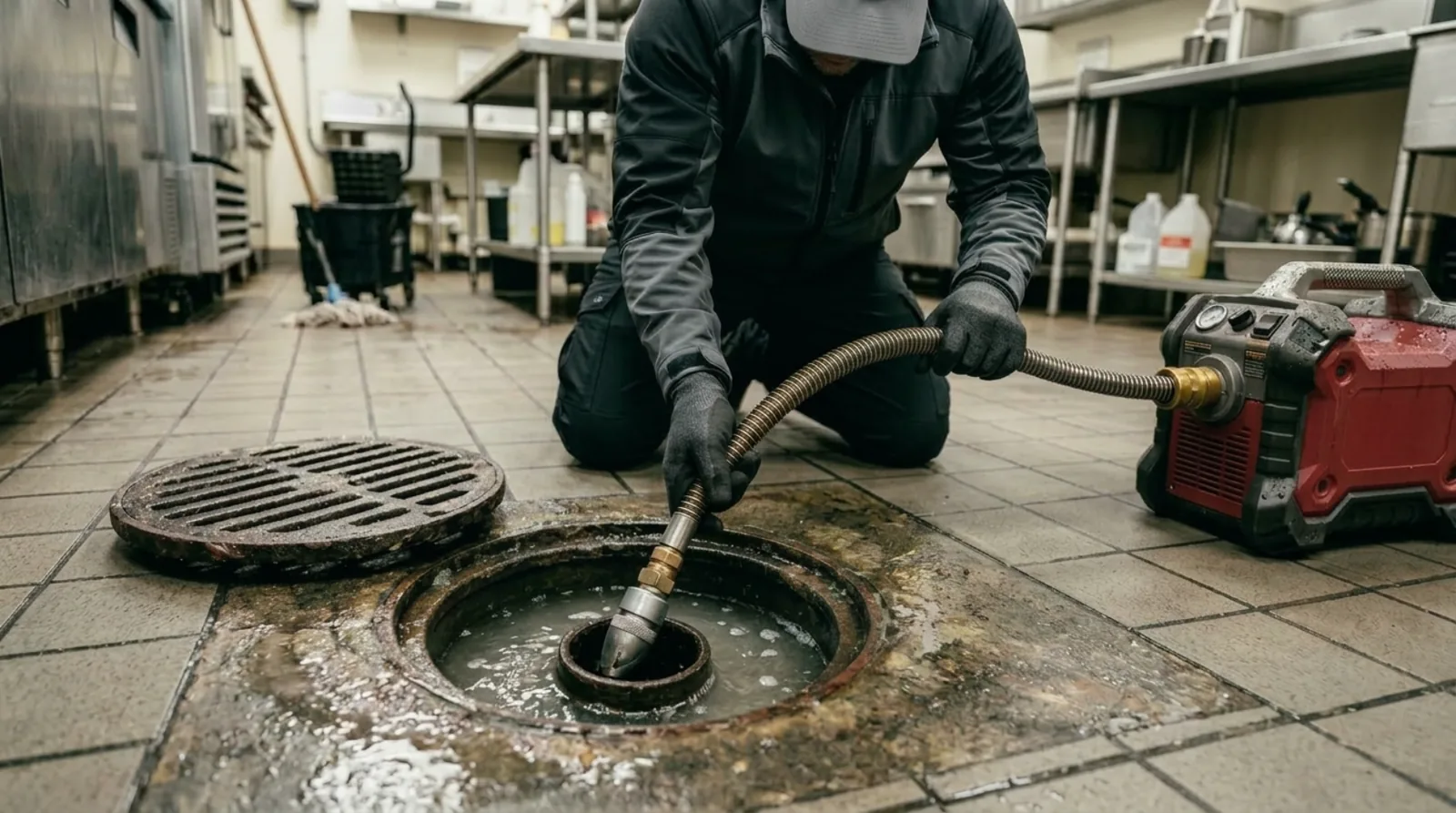
Drain and grease line service on a schedule. The single highest-value item for food service. Kitchen lines handling daily FOG loading need scheduled hydro-jetting at an interval set by actual volume, not by when the line last backed up. A scheduled after-hours jetting is a planned expense. An emergency backup during Friday dinner service is a closure.
Grease interceptor inspection and pumping records. Most Inland Empire jurisdictions require food service establishments to maintain interceptors and keep documentation. Failed interceptors send grease into the municipal system and create both a compliance problem and a liability.
Flushometer and fixture service. Diaphragm kits wear. A running flushometer can waste enormous volumes of water continuously and the meter records every gallon. Systematic fixture checks catch the running urinal nobody reported.
Backflow assembly testing. Testable assemblies protecting the potable supply generally require annual certification by a certified tester, with results filed with the water purveyor. Missing a test window creates a compliance issue on a predictable calendar. Gardner Plumbing Co. provides backflow prevention services for commercial properties.
Water heating system service. Commercial water heaters and boilers under continuous demand accumulate scale faster than residential units, particularly in hard-water areas across the Inland Empire. Descaling, anode inspection, and relief valve verification on a schedule prevent the mid-service failure.
Leak and pressure surveys. A running fixture or a slab leak in a 20,000 square foot building can hide for months inside a normal-looking bill. Periodic meter checks and pressure readings surface what nobody sees.
Water Efficiency Is a Line Item You Control
Commercial water and sewer charges are a real operating expense, and sewer is frequently billed off water consumption — meaning a leak is billed twice. The EPA's WaterSense guidance for commercial buildings documents where consumption concentrates in commercial facilities and which measures produce the largest reductions.
In practice, the biggest wins are unglamorous: fixing continuously running flushometers, replacing worn fixture components, correcting overpressure that drives every fixture to use more than it needs, and metering irrigation separately where the jurisdiction permits it. Our post on hidden water waste covers the same mechanisms at residential scale.
Industry-Specific Priorities
Restaurants and food service: grease line jetting, interceptor compliance, three-compartment sink drainage, floor drains and trap primers, dish machine supply and booster heaters.
Offices and professional buildings: restroom fixture reliability, flushometer service, water heater or point-of-use heater maintenance, ADA fixture compliance, and clean restrooms as a tenant-retention factor.
Medical and dental: hot water reliability and temperature consistency, backflow protection on equipment connections, and drainage that cannot be allowed to fail during patient hours.
Retail and multi-tenant: shared line responsibility, isolation valves that allow one tenant to be serviced without shutting the building, and clear documentation of what belongs to whom.
Warehouse and light industrial: restroom and break-room fixtures, hose bibs and wash-down stations, and process-related drainage. Gardner Plumbing Co. also handles industrial plumbing requirements at this scale.
The Case Against Reactive-Only
Businesses that call a plumber only when something fails pay three premiums at once: emergency rates instead of scheduled rates, work performed during operating hours instead of after close, and lost revenue for the duration. A grease line jetted on a Tuesday at 6 AM costs a fraction of the same line opened at 7 PM on a Saturday with a dining room full of people — and only one of those two scenarios also costs a night of sales and a handful of reviews.
Documentation matters too. A maintained system with dated service records supports insurance claims, satisfies health inspectors, and gives a property manager something concrete when a tenant disputes responsibility. That record does not exist if the only file is a stack of emergency invoices.
Building a Program That Fits
A workable commercial program starts with a walkthrough: fixture inventory, water heating equipment, backflow assemblies, grease handling, isolation valve locations and function, and a camera inspection of the main lines to establish a baseline. From there the schedule is built to the building's actual usage — quarterly jetting for a high-volume kitchen, annual service for a low-traffic office suite.
Gardner Plumbing Co. provides commercial plumbing service and scheduled maintenance for businesses and property managers across Riverside County and neighboring communities, with written estimates before work begins and after-hours scheduling to keep operations running. CSLB #1073177, 30+ years in business, 900+ five-star Google reviews. Residential maintenance plans are available as well.
Need a commercial plumbing partner instead of an emergency number? Call (951) 246-4337 to schedule a facility walkthrough. Gardner Plumbing Co. serves businesses in Temecula, Murrieta, Menifee, Corona, Riverside, Moreno Valley, Hemet, and 20+ cities across Riverside County and neighboring communities.