Leak Detection
How to Use Your Water Meter to Detect Leaks
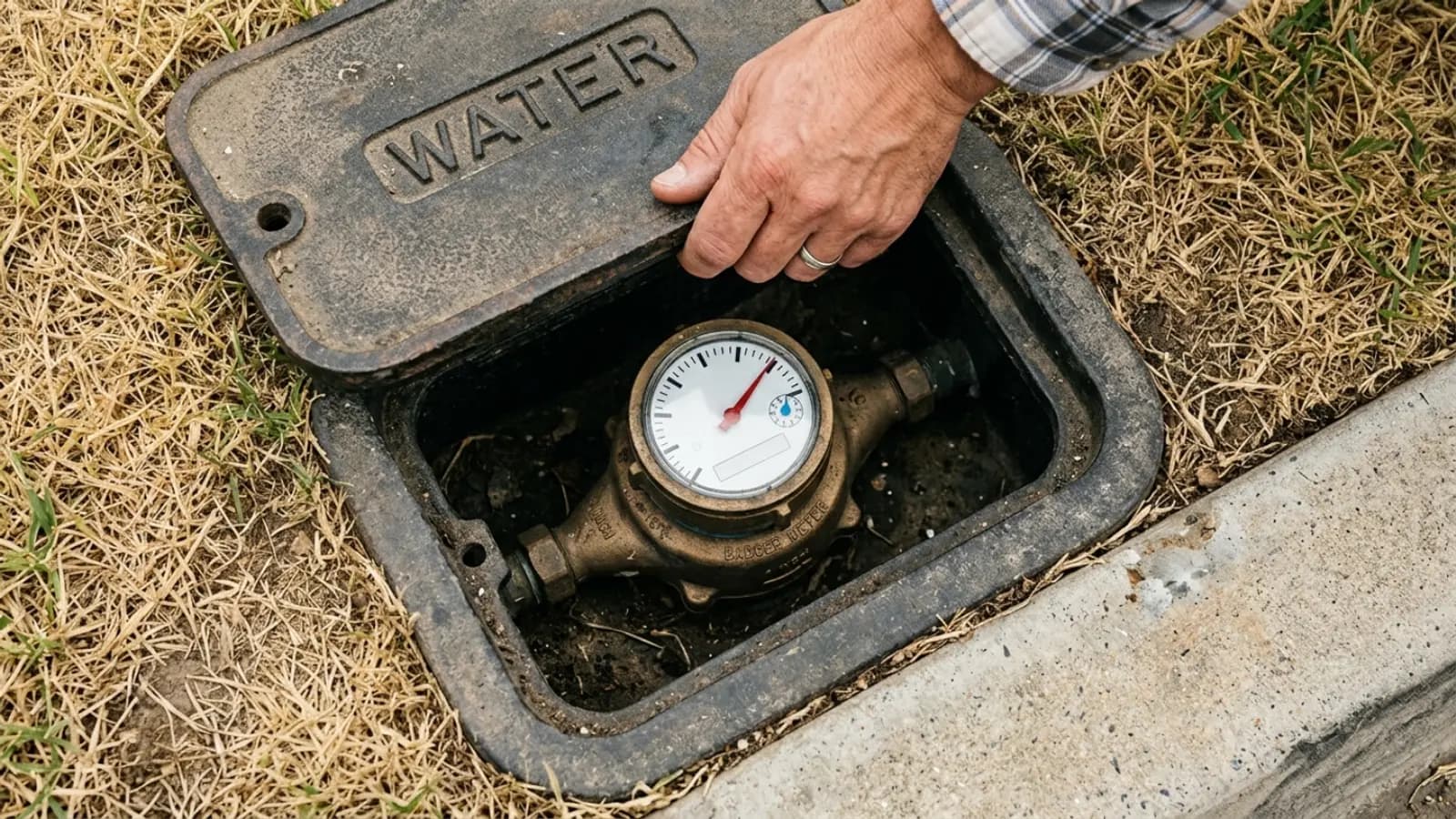
Hidden water leaks can be a serious problem. Because they occur behind walls, under foundations, or underground in the yard, they can waste thousands of gallons and cause costly structural damage before anyone notices. For residents in Temecula, Murrieta, Lake Elsinore, Menifee, Hemet, and Corona, early detection is the key to minimizing repair costs and conserving water. The good news is that most homes already have a built-in diagnostic tool near the street: the water meter. Learning to read and use it is one of the most practical homeowner skills available.
Finding and Reading Your Meter
The water meter typically sits in a concrete or plastic box flush with the ground near the street, curb, or property line. The lid can usually be lifted with a large flathead screwdriver or a meter key. Wear gloves and lift carefully — spiders or insects sometimes take up residence inside. Once the lid is off, the meter face may be covered by a small protective cap that flips open.
Meters in Riverside County may be analog or digital. Analog meters show total water use on a dial and include a small leak indicator — often a red or black triangle, star, or gear. Digital meters may display a droplet icon or a flow rate in gallons per minute. Even newer meters that transmit readings electronically to the utility still have a face you can read directly in the box.
Running the Leak Test
Before testing, confirm that no water is being used anywhere on the property. Shut off faucets, showers, and water-using appliances — including the dishwasher, washing machine, and ice maker. Pause any timed irrigation, turn off pool auto-fill systems, and make sure water softeners and reverse osmosis units are not in a regeneration cycle. In Menifee and Wildomar, where many homes irrigate in the early morning, schedule the test for a time when sprinkler programs are fully off.
With the property "dry," check the meter’s leak indicator. On an analog meter, the small triangle or star should be completely still if no water is moving. If it is spinning or twitching — even slowly — water is flowing through the meter and leaking somewhere in the system. On a digital meter, any flow rate above zero or a displayed leak icon indicates the same thing.
If the indicator is too subtle to read at a glance, use a timed reading: write down the exact numbers on the main register, then do not use any water for one to two hours. Any increase in the reading during that window confirms a leak. For a quicker estimate, record the reading, wait 10 minutes, and check again — any increase shows active flow.
Isolating Indoor vs. Outdoor Leaks
Once a leak is confirmed, the next step is narrowing down whether it is inside the home or in the yard and service line. Find the main shutoff valve where the water line enters the house — or near the hose bib closest to the front of the property — and turn it off. Do not touch the valve on the street side of the meter; that belongs to the water utility.
With the home’s main valve closed, check the meter again. If the indicator stops, the leak is inside the house. Common indoor culprits include a running toilet (confirm with a dye test — add food coloring to the tank and watch for color in the bowl after 10 minutes), a dripping faucet, a failing water softener, or a hidden pipe leak in a wall or under the slab. If the meter continues to show flow when the main house valve is off, the leak is outdoors — between the meter and the house, in a service line underground, or in an irrigation system. Signs of an outdoor service line leak include soggy spots in the yard, grass that stays greener in one specific area, or hissing sounds near hose bibs. Before any digging in the yard, contact 811 to have underground utilities marked.
For more on identifying and stopping hidden waste throughout the home, see our guide on hidden water waste and how to stop it.
Understanding the Numbers
Many local meters in Riverside County measure in gallons; others use cubic feet. One cubic foot equals approximately 7.48 gallons. If a meter shows 0.01 cubic feet passing in one minute, that is roughly 0.075 gallons per minute — which adds up to more than 100 gallons per day from a single leak. In communities like Corona, Riverside, and Perris where tiered water rates apply, even a slow leak can push a household into a higher cost tier quickly. The American Water Works Association provides resources on water loss and conservation that put these numbers in context for residential water systems.
Conditions That Can Cause False Readings
Some equipment causes meter movement that is not a leak. A water heater without an expansion tank on a closed system may push small amounts of water back and forth as it heats, causing a sensitive indicator to twitch briefly. A water softener or filter that regenerates on a timed schedule pulls water at night. Recirculation pumps and refrigerator ice makers can cycle without notice. To reduce false positives, turn off these devices during the test and run it during a quiet time of day when household systems are not cycling.
What to Do When You Confirm a Leak
When a leak is confirmed, homeowners have several options depending on the location and severity: a targeted repair (replacing a toilet flapper, fixing a single pipe joint), a section of service line repair or replacement, trenchless repair where feasible to minimize yard disruption, or a more extensive repipe in aging homes. Gardner Plumbing Co. presents all options with photos and video documentation from camera inspections and electronic locating equipment — so you see exactly what the technician sees before deciding. Upfront flat-rate pricing applies to all services, and financing is available for qualifying projects like repiping or slab leak repairs.
For ongoing protection, Moen Flo smart monitoring systems installed by Gardner Plumbing Co. provide real-time water usage data and automatic shutoff when an abnormal flow pattern is detected — essentially turning your plumbing system into a 24/7 self-monitoring network. Some homeowners insurance carriers offer premium discounts for approved smart leak detection systems.
If a substantial leak, a burst pipe, or signs of a slab leak are present, act immediately. Every minute of running water increases damage risk. Gardner Plumbing Co. is available for emergency plumbing service throughout Riverside County. The company has served the region for 30+ years, carries a 4.9-star average across 900+ Google reviews, and is licensed under CSLB #1073177.
Confirmed a leak or suspect one? Call (951) 246-4337 — no trip fees, no obligation. Gardner Plumbing Co. serves Temecula, Murrieta, Menifee, Lake Elsinore, Hemet, and 20+ additional cities across Riverside County.
Your Meter Is Always On Duty
The water meter test is free, takes less than five minutes, and can catch a leak that might otherwise go undetected for months. Run it quarterly, any time a water bill is unexpectedly high, and before leaving on an extended vacation. That simple habit — combined with professional follow-up when a leak is confirmed — puts you firmly in control of your home’s water system and your utility costs.