Plumbing Basics
Water Pressure Problems and Solutions
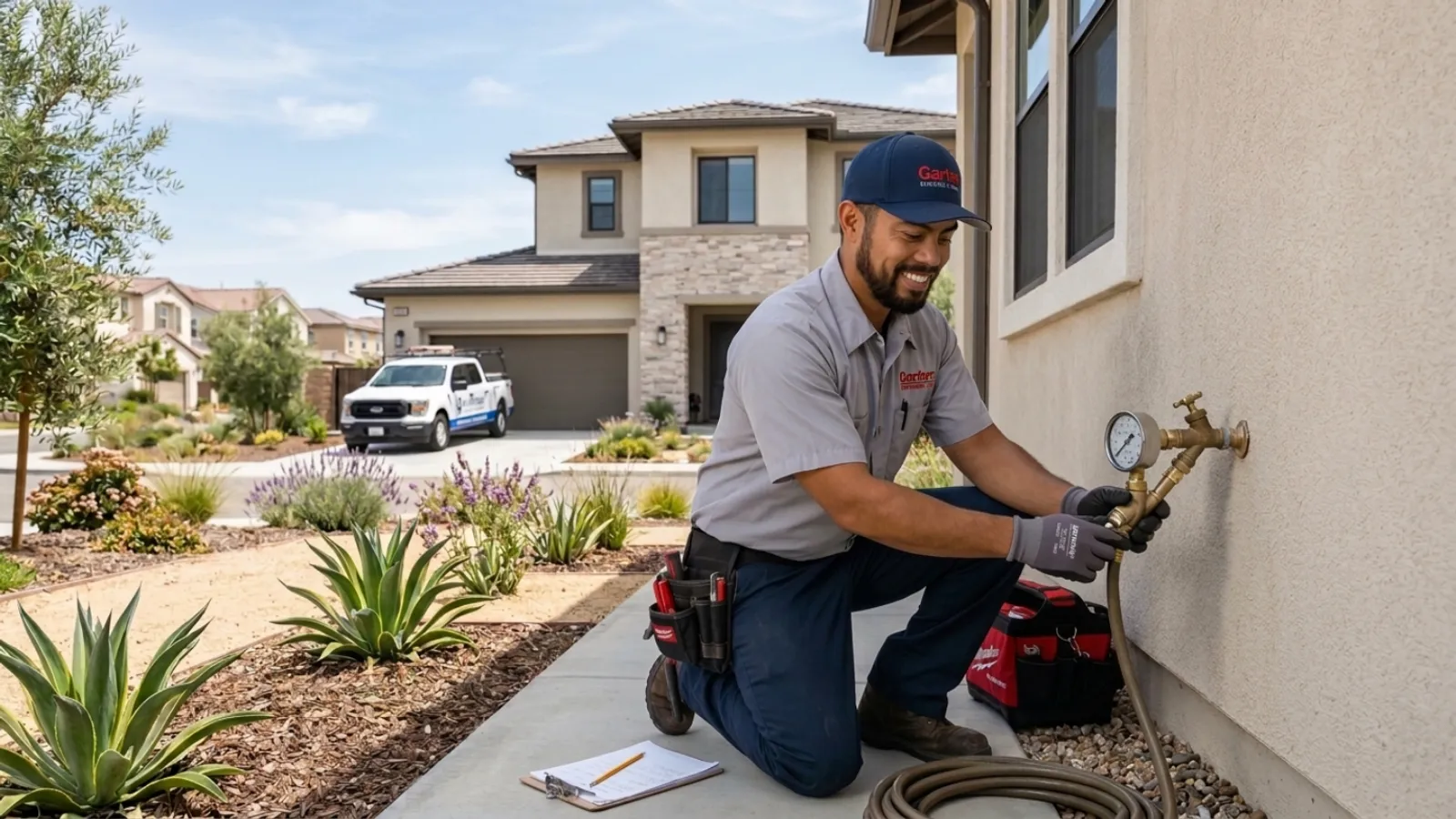
Water pressure is one of those plumbing fundamentals that goes unnoticed when it is correct and becomes impossible to ignore when it is not. A weak shower that barely rinses shampoo, or a pipe that bangs every time the washing machine cuts off — both are signs that pressure is outside the optimal range. For homeowners in Temecula, Murrieta, Menifee, Lake Elsinore, and across Riverside County, pressure problems are common because the municipal supply can vary significantly by zone, and many homes have aging pressure-control hardware that is overdue for attention.
How to Test Your Home’s Water Pressure
The fastest way to measure pressure is with a simple hose-bib pressure gauge, available at any hardware store for under $20. Thread it onto an outdoor spigot near the water meter, make sure all fixtures inside the house are off, and open the bib fully. The reading shows your home’s static pressure — what the supply line delivers at rest.
Normal residential pressure falls between 50 and 80 PSI. California plumbing code sets 80 PSI as the upper limit before a pressure reducing valve (PRV) is required. If your reading lands between 50 and 80, pressure itself is unlikely to be the source of a plumbing complaint. A reading below 40 or above 80 warrants attention. Test at different times of day — morning peak demand can temporarily drop municipal pressure, while overnight the line may read higher than daytime. A professional plumbing inspection can capture readings at multiple points to distinguish a whole-house issue from a localized one.
Signs Your Pressure Is Too High
High pressure is the quieter danger. Pipes and fixtures are rated for operation up to around 80 PSI, and sustained pressure above that threshold stresses every joint, valve, and fitting in the home.
- Banging or water hammer — a thud or bang when a valve closes sharply. High pressure turns the mass of water in the line into a pressure spike that rattles pipes.
- Toilet fill valve failures — fill valves are rated for normal pressure ranges. Chronic high pressure wears the diaphragm faster, causing toilets to run intermittently or fail to shut off.
- Dripping supply lines and hose bibs — braided stainless supply lines under sinks and behind appliances are most prone to weeping at the end connections when pressure exceeds their design range.
- Appliance hose failures — washing machine inlet hoses and refrigerator ice-maker lines are a leading cause of residential water damage; high pressure dramatically shortens their safe service life.
- Pinhole leaks — repeated pressure spikes over years cause micro-fatigue in copper pipe walls, eventually producing the pinhole leaks that Riverside County slab homes are especially vulnerable to. An unexplained spike in your water bill is often the first clue.
Some zones in Riverside County — particularly neighborhoods on the receiving end of an aggressive municipal supply or at the lower end of a pressure zone — can see residential readings well above 80 PSI. If your gauge reads high, this is not something to monitor passively.
Signs Your Pressure Is Too Low
Low pressure is the more noticeable complaint, though it is not always a supply issue. Symptoms include:
- Weak shower flow that worsens when another fixture runs simultaneously
- Toilets that fill slowly after flushing
- Uneven flow between fixtures — strong at the kitchen sink, weak in the master bath
- Irrigation zones that fail to reach full coverage
Hillside zones in Riverside County — including parts of Lake Elsinore, Canyon Lake, and Temecula wine country — can have naturally lower supply pressure because water must travel uphill to reach elevated neighborhoods. Homes in these zones sometimes see readings at or below 45 PSI, which is functional but leaves little margin for multiple simultaneous demands.
Root Causes and the Right Fix
Failed pressure reducing valve (PRV). The PRV — a bell-shaped device on the main supply line, often near the water meter or at the point the line enters the house — is the most common hardware cause of both high and low pressure. When a PRV fails open, pressure climbs to whatever the municipal supply delivers. When it fails closed or gets clogged with debris, pressure drops. PRVs are adjustable within a range, but a unit that cannot hold a setting or drifts over time needs replacement. The typical PRV lifespan is 10 to 15 years; many homes in Temecula, Murrieta, and Menifee have original PRVs from tract construction in the 1990s and 2000s that are now at or past that window.
Expansion tank check. Homes on a closed water supply system — where a backflow preventer or check valve prevents water from returning to the main — need a thermal expansion tank near the water heater. Without one, heated water has nowhere to expand and drives pressure up in bursts. If your pressure reading is inconsistent, especially after hot-water demand, an expansion tank evaluation is warranted.
Clogged aerators and showerheads. When low pressure is limited to one fixture or zone, the cause is often local. Aerators on kitchen and bathroom faucets trap sediment and mineral scale from Riverside County’s hard water. Remove the aerator (counterclockwise), soak in white vinegar overnight, and reinstall. Showerhead nozzles clog the same way. If flow restores after cleaning, no further work is needed.
Corroded galvanized pipes. Homes built before the mid-1980s in neighborhoods like older Hemet, Riverside, and Perris may still have galvanized steel supply lines. Galvanized pipe corrodes from the inside out, and decades of mineral buildup can reduce the effective interior diameter to a fraction of its original size. Low pressure that worsens progressively over the years, or that differs significantly between hot and cold lines, points here. A whole-home repipe with copper or PEX is the permanent solution.
Partially closed main shutoff. After any repair involving the main shutoff, the valve must be opened fully. A gate valve that is only three-quarters open restricts flow to the entire house. Check the main shutoff and the meter valve; both should be fully open. If the main shutoff is a gate valve that has become difficult to turn, have it evaluated — a stuck or partially closed gate valve can resemble a pressure problem but is simply a valve issue. Our guide on locating and using your main shutoff valve covers what to look for.
Municipal supply issues. If a pressure gauge confirms the home’s PRV is working correctly but supply pressure at the meter is abnormal, the issue is upstream. Contact your water provider — Eastern Municipal Water District, Western Municipal Water District, or Rancho California Water District, depending on your city — to report the reading and ask about known pressure variations in your zone. Persistent municipal low pressure in a hillside area may have no simple fix, though a booster pump system is an option a licensed plumber can evaluate.
Pressure Spikes and Pinhole Leaks
High pressure is one of the primary causes of pinhole leaks in copper pipe — a chronic problem for Riverside County slab homes. When the pipe wall is stressed repeatedly by pressure spikes, micro-failures develop over time. A small leak inside a slab may go undetected for months before a water bill spike or warm floor spot reveals it. Keeping home pressure in the 55–75 PSI range with a properly set PRV is one of the most cost-effective things a homeowner can do to reduce long-term leak risk. If you suspect a slow leak, the water meter test is a simple first step. For a deeper look at what hidden leaks look like, see our guide on signs of a hidden water leak in Riverside County.
The International Association of Plumbing and Mechanical Officials (IAPMO), which governs the Uniform Plumbing Code adopted in California, includes specific provisions for pressure limiting devices in residential systems — a recognition that uncontrolled pressure is a significant source of plumbing failures.
Pressure issue or want a free in-home reading? Call (951) 246-4337 — no trip fees, no obligation. Gardner Plumbing Co. serves Temecula, Murrieta, Menifee, Lake Elsinore, Hemet, and 20+ additional cities across Riverside County. CSLB #1073177.
The Right Pressure Is Worth Getting Right
A $20 gauge and 10 minutes can tell you whether pressure is a problem in your home. A PRV replacement that brings pressure into the correct range protects every fixture, valve, and pipe in the building — and eliminates the conditions that cause pinhole leaks to develop quietly inside slab foundations. Gardner Plumbing Co. has served Riverside County for 30+ years, holds CSLB #1073177, and offers flat-rate pricing on all pressure-related work, from gauge testing and PRV replacement to whole-home repipes for homes where corroded galvanized pipes are the root cause.