Water Quality
Hard Water Solutions: Water Softeners and Filtration Systems
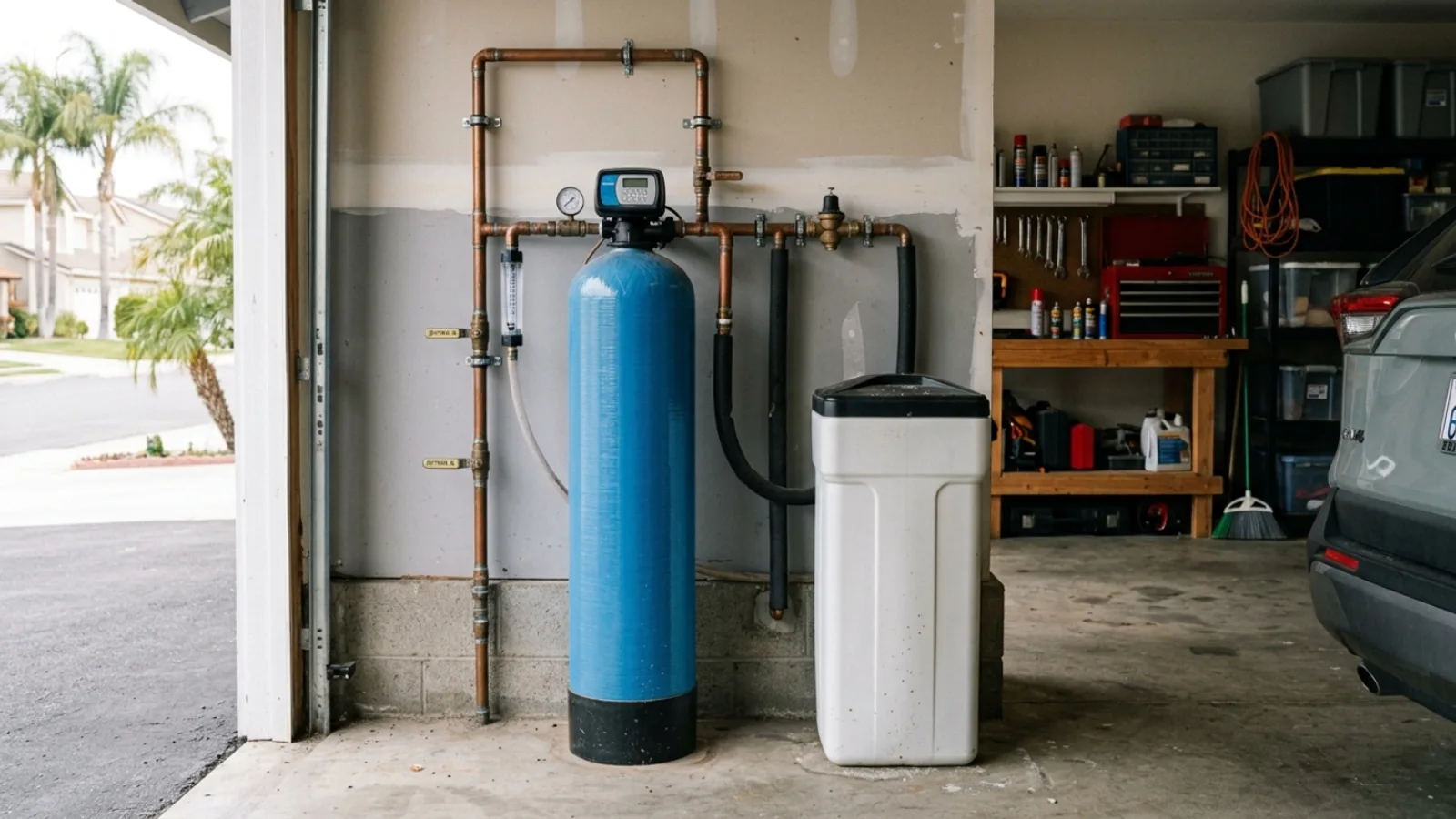
Hard water is a daily reality for most homeowners across Riverside County. With mineral content typically running 10–20 grains per gallon in communities like Temecula, Murrieta, Menifee, Lake Elsinore, and Hemet, calcium and magnesium accumulate everywhere water touches — inside pipes, water heaters, dishwashers, faucet aerators, and shower glass. The effects are visible in spots on dishes, stiff laundry, dry skin, and scale buildup that reduces appliance efficiency over time. The solution depends on what problem you are trying to solve — and the right answer is often a combination of systems. For homeowners who suspect hard water is already affecting their plumbing infrastructure, see our post on hard water damage to pipes and fixtures.
How Water Softeners Work
A traditional ion-exchange water softener is the most effective solution for removing hardness minerals. Water enters the home and passes through a resin bed charged with sodium ions. The resin attracts and traps calcium and magnesium, releasing sodium in exchange. Periodically, the system flushes the resin with a brine solution to remove accumulated minerals and recharge the beads. The result is genuinely soft water — no scale buildup inside pipes, water heaters, or appliances. Soaps and detergents lather better, less product is needed, and glass shower doors stay cleaner with less effort. The EPA's WaterSense program recognizes that protecting plumbing from scale extends the useful life of both the system and water-using appliances.
Salt-Free Conditioners: A Different Approach
Salt-free conditioners change how minerals behave so scale does not stick as easily, but they do not remove calcium and magnesium from the water. They can reduce spotting on fixtures and slow surface buildup — making them a reasonable choice for homeowners who want lower maintenance without adding salt or dealing with brine discharge. The trade-off is that they do not provide the same full protection inside water heaters and appliances that a true ion-exchange softener delivers. Some communities in Riverside County also have discharge restrictions on brine waste; a licensed plumber can advise on local requirements. Modern high-efficiency softeners minimize salt consumption and discharge volume significantly.
Why Filtration Is Still Needed Even With a Softener
A water softener addresses hardness — but it does not filter out chlorine, chloramines (used by many Southern California water agencies for disinfection), sediment, or volatile organic compounds (VOCs). A whole-house water filtration system installed upstream of the softener protects the resin bed from chlorine degradation and delivers better-tasting, better-smelling water from every tap. The standard combined setup is: sediment pre-filter → carbon or catalytic carbon filter (for chloramines) → water softener. For drinking and cooking, a reverse osmosis (RO) unit at the kitchen sink polishes water further — removing the sodium added by softening and a broad range of dissolved substances.
Hardness Levels Across Riverside County: Why Location Matters
Water hardness in Riverside County is not uniform — it varies by water district and source blend. Understanding your local supply helps set realistic expectations for what treatment is needed:
- Temecula / Murrieta / Menifee (Eastern MWD blend): Hardness typically runs 12–18 GPG. Colorado River water blended with local groundwater. Chloramines used for disinfection, which requires catalytic carbon rather than standard carbon for effective filtration.
- Hemet / San Jacinto (Valley-Wide MWD): Often 14–20 GPG depending on groundwater contribution. Some of the hardest water in the region. Water heater element failure and scale buildup on fixtures are common complaints.
- Lake Elsinore / Wildomar: Varies 12–17 GPG. City of Lake Elsinore sources include local wells and imported water.
- Corona / Norco: Hard water in the 10–15 GPG range. Western Municipal Water District supply with similar chloramine treatment.
- Riverside / Moreno Valley: Groundwater from the Bunker Hill Basin and Riverside Basin can test 10–18 GPG depending on well contribution levels at any given time.
A professional water test — not a generic estimate — is the only way to size and configure treatment equipment correctly for your specific address. Gardner Plumbing Co. provides this as the first step in any water treatment consultation.
Sizing, Maintenance, and Installation Considerations
A properly sized softener is matched to household water hardness level and daily usage. An undersized unit regenerates too frequently; an oversized one wastes salt. Flow rate matters too — equipment should handle peak demand without causing pressure drops during showers, laundry, and dishes running simultaneously. Softeners need a nearby drain for brine discharge and a standard electrical outlet. Sediment filters need replacement every three to six months. Carbon media typically lasts one to five years. UV lamps, if used, require annual replacement. Keeping a maintenance schedule ensures consistent performance and protects the equipment investment. Gardner Plumbing Co. performs professional water testing, documents results with photos and video, and presents system options with pros and cons before any installation — with flat-rate pricing so homeowners know the investment before work begins. Financing is available for qualifying projects. CSLB #1073177.
Dealing with hard water or water quality concerns? Call (951) 246-4337 — no trip fees, no obligation. Gardner Plumbing Co. serves Temecula, Murrieta, Menifee, Lake Elsinore, Hemet, and 20+ additional cities across Riverside County.
The Right Solution Depends on Your Water Test
No two water supplies are identical. A professional water test identifies what is actually in your water — hardness level, chlorine or chloramine presence, sediment load, VOCs — before any system is recommended. Gardner Plumbing Co. technicians conduct testing, explain the results clearly, and recommend a combination of softening and filtration that matches your household's goals, budget, and maintenance preferences. That is the only way to build a water treatment system that actually performs as expected.