Water Quality
Whole-House Water Filtration: Is It Worth the Investment?
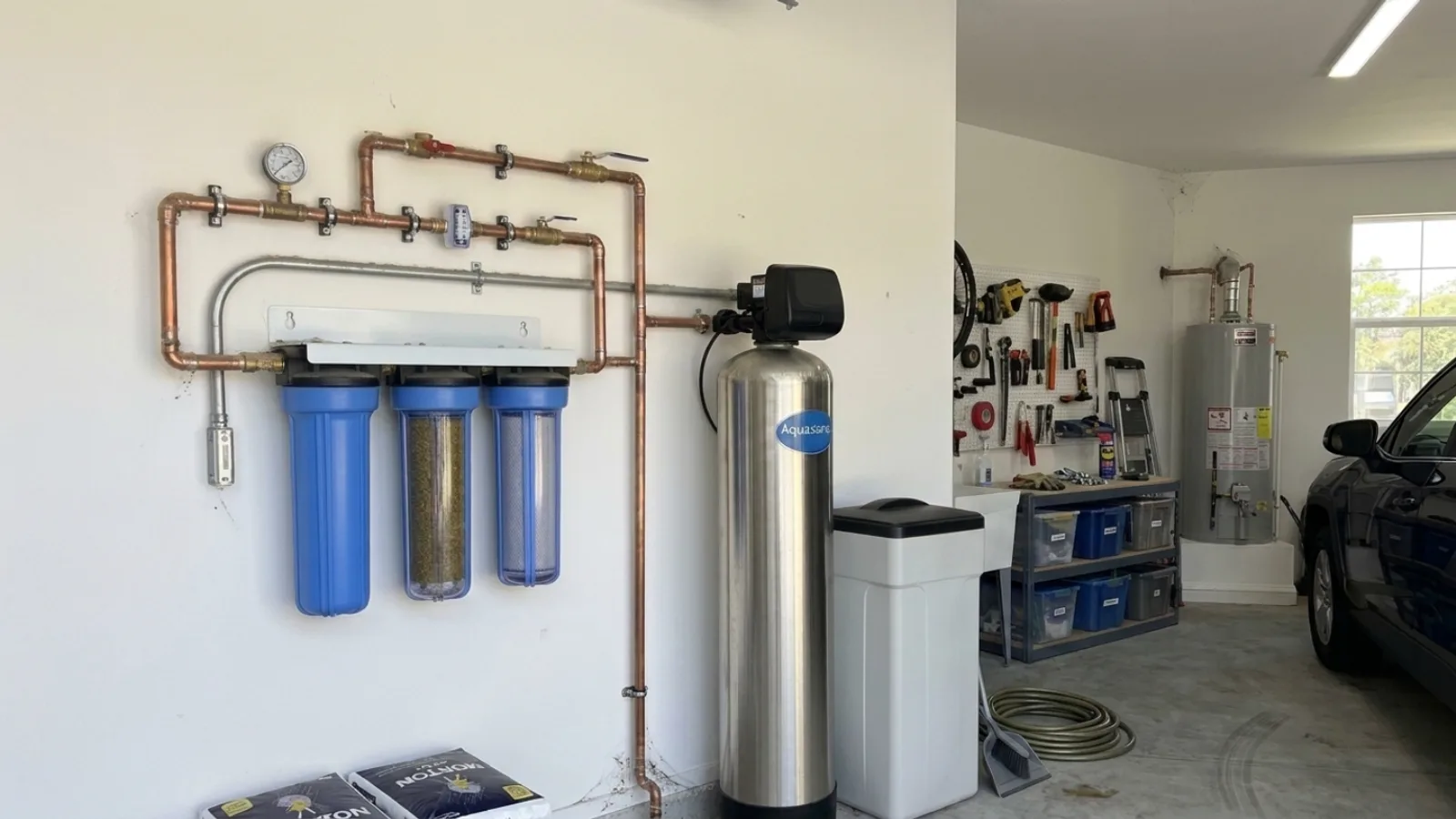
Municipal water in Riverside County meets federal safety standards — but "safe" and "ideal for your home's plumbing and your family's comfort" are different things. Chlorine or chloramines used for disinfection leave taste and odor issues. Fine sediment from line work and main breaks reaches the tap. Hard water causes scale inside appliances and water heaters. For homeowners in Temecula, Murrieta, Menifee, Lake Elsinore, Hemet, and Corona, a whole-house water filtration system addresses these concerns at the point where water enters the home, so every tap — shower, laundry, kitchen, bathroom — delivers treated water. The question most homeowners ask is whether the investment is justified.
What a Whole-House System Actually Does
A point-of-entry (POE) system is installed on the main supply line before water branches to any fixture. Unlike pitcher filters or faucet attachments, it treats 100% of the home's water. The most common setup combines a sediment pre-filter (catches sand, silt, and rust), a carbon or catalytic carbon filter (removes chlorine and chloramines, improves taste and odor, reduces some VOCs), and optionally a UV disinfection stage (effective for microbiological concerns on well water or post-main-break situations). For drinking and cooking, an under-sink reverse osmosis unit polishes the kitchen tap further. A POE system does not soften water — hardness minerals require a separate softener or conditioner, which is often installed in the same sequence. Whole-house filtration installation is a service Gardner Plumbing Co. provides with professional water testing as the first step. The EPA's National Primary Drinking Water Regulations set the baseline — but many homeowners choose filtration to go beyond that baseline for taste, comfort, and fixture protection.
The Case for Whole-House Filtration in Riverside County
Several local factors strengthen the argument. Many Southern California water agencies use chloramines rather than plain chlorine for disinfection — and chloramines require catalytic carbon rather than standard carbon to be effectively reduced. Hard water in the 10–20 GPG range scale-coats water heater elements, reducing efficiency and shortening appliance life. Homes that have had recent main breaks or line repairs may see elevated sediment temporarily. For homeowners who have already invested in a repipe or new appliances, a filtration system protects that investment. The long-term value also shows up in reduced bottled water spending and potentially longer appliance service intervals. Understanding how softeners and filtration work together helps clarify the right combination for each household's specific water profile.
What to Look for in a System
NSF/ANSI certifications confirm that a filter performs as claimed. Look for NSF 42 (aesthetic — taste and odor), NSF 53 (health effects — specific contaminants), or NSF 401 (emerging contaminants) depending on your filtration goals. Flow rate is a critical spec — the system must meet peak household demand without causing noticeable pressure drops. A proper installation includes bypass valves for maintenance, easy cartridge access, pre- and post-pressure gauges to track filter life, a code-compliant drain, and a pressure regulator if supply pressure exceeds 80 PSI. Each of these details affects long-term performance; they should be confirmed before installation, not discovered afterward. For homes with active hidden leak concerns, Gardner Plumbing technicians check plumbing condition before any system installation — identifying any upstream issues that should be resolved first.
Maintenance Keeps the System Effective
A neglected filter eventually performs worse than no filter at all — clogged media can allow bacterial growth or reduce pressure significantly. Sediment cartridges need replacement every three to six months depending on water quality and usage. Carbon media typically lasts one to five years in a tank-style system; cartridge-based carbon changes every six to twelve months. UV lamps need annual replacement. A simple maintenance schedule posted near the equipment removes the guesswork. Gardner Plumbing Co. provides flat-rate installation pricing, explains ongoing maintenance requirements before the project starts, and offers financing for qualifying projects. CSLB #1073177.
The Real Cost Comparison: Filtration vs. the Alternative
Whole-house filtration systems range from entry-level cartridge-based setups to multi-stage tank systems. The investment spans a wide range depending on system type, flow rate, and whether softening is included. The comparison that matters is not the upfront cost alone — it is the cost relative to the problems the system prevents:
- A water heater operating in 18 GPG hard water without a softener loses measurable efficiency within two to three years as the element and tank interior scale up. Early replacement adds to lifetime operating cost.
- Scale damage to dishwashers, washing machines, and ice makers shortens appliance service life — a cost that is rarely attributed to water quality until a technician points it out.
- Bottled water spending for a household of four often runs $50–$100 per month — $600–$1,200 per year — for a problem a point-of-entry system with an RO tap largely eliminates.
- Chloramine exposure in shower steam is a legitimate concern for households with sensitivities. A whole-house carbon stage removes this at the source rather than requiring a separate shower filter on every fixture.
Framed this way, the payback period for a quality whole-house system is often three to five years when appliance protection, bottled water savings, and reduced scale maintenance are factored together. Gardner Plumbing Co. does the math honestly with homeowners during the consultation — no inflated claims, no products pushed beyond what the water test actually indicates.
Ready to explore water filtration options? Call (951) 246-4337 — no trip fees, no obligation. Gardner Plumbing Co. serves Temecula, Murrieta, Menifee, Lake Elsinore, Hemet, and 20+ additional cities across Riverside County.