Drain Care
Why Hydro-Jetting Is the Best Solution for Stubborn Clogs
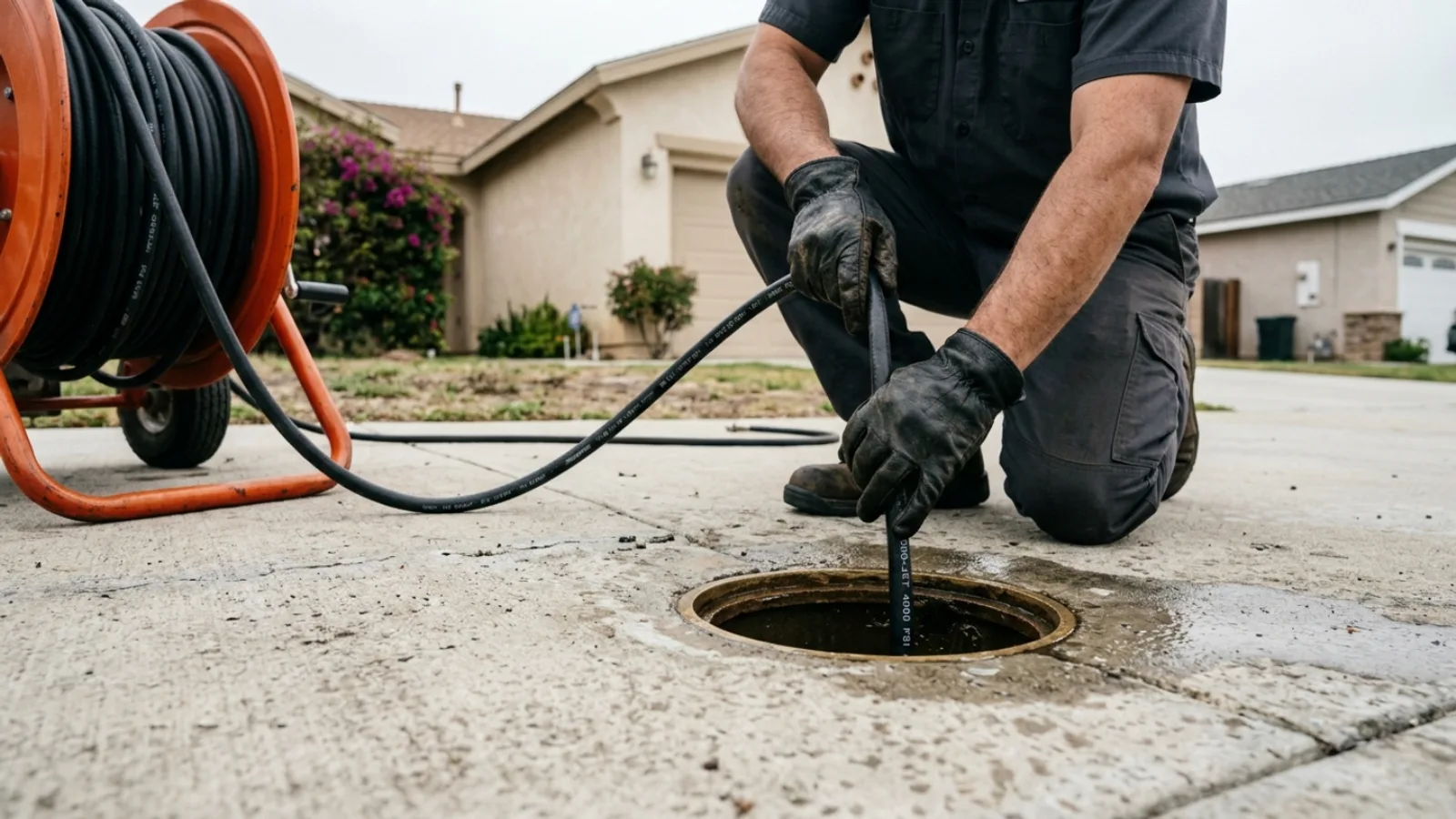
A plunger handles most minor kitchen and bathroom clogs. A drain snake gets a little deeper. But when grease has coated the pipe walls for years, tree roots have colonized the sewer lateral, or mineral scale has narrowed a drain line to a fraction of its original diameter, neither tool is adequate. For homeowners in Riverside County — including Temecula, Murrieta, Menifee, Lake Elsinore, Hemet, and Corona — hydro-jetting is the most effective solution for stubborn blockages that keep coming back.
How Hydro-Jetting Works
Hydro-jetting delivers highly pressurized water — up to 4,000 PSI — through a flexible hose with a specialized nozzle that scours the full interior diameter of the pipe. Rear-facing jets pull the hose forward through the line while forward jets cut through blockages and buildup. Technicians select different nozzles — penetrating, rotating, or root-cutting heads — based on the type of clog and pipe material. The result is a pipe interior that is genuinely clean, not just punched through. A video sewer inspection always precedes jetting to confirm pipe condition and identify any structural problems that would require repair rather than cleaning.
Where Hydro-Jetting Outperforms Snaking
A mechanical snake punches a channel through a grease clog and restores temporary flow — but leaves the sticky film coating the pipe walls behind. That film catches new debris and the clog returns, often faster than before. Hydro-jetting removes the film itself, reducing the frequency of repeat service calls. The same advantage applies to mineral scale from Riverside County's hard water: rotating jetting nozzles break up and flush calcium and magnesium deposits that snaking cannot touch. For tree root intrusion, hydro-jetting slices fine roots and flushes debris, whereas an auger may cut through the mass but leave fibers that resprout. See our post on tree root intrusion for the full treatment picture when structural repair is also needed. The International Association of Plumbing and Mechanical Officials (IAPMO) recognizes hydro-jetting as an industry-standard method for effective drain and sewer maintenance.
When Hydro-Jetting Is the Right Call
Hydro-jetting is most appropriate for recurring clogs that snaking has not resolved, kitchen lines with heavy grease accumulation, sewer laterals with root intrusion, and homes with cast iron or clay lines showing scale buildup. It is also one of the best preventive maintenance tools for homes near mature trees or with older clay lines — scheduled jetting every few years keeps the line clear and catches developing issues before they become emergencies. Hydro-jetting is not appropriate for pipes that are already structurally compromised — cracked, collapsed, or severely offset sections need trenchless repair or replacement first. That is precisely why the camera inspection before jetting is non-negotiable. Concerns about recurrent drain clogs are also a strong signal to evaluate the line with a camera before attempting further cleaning.
Why Hard Water Makes Hydro-Jetting More Valuable in Riverside County
Riverside County water runs 12–20 grains per gallon of hardness — high enough that calcium and magnesium deposits build visibly inside pipes within years, not decades. In a kitchen drain line that also sees cooking grease, the two combine: scale creates rough surface texture that catches grease molecules and accelerates buildup faster than either deposit would on its own. Standard snaking breaks through the accumulated mass but cannot clean the pipe wall surface. After a snake, the rough scale-and-grease coating remains and the cycle restarts within weeks or months. Hydro-jetting at adequate pressure (typically 2,500–4,000 PSI for residential lines, depending on pipe age and material) removes both the blockage and the wall buildup that caused it — effectively extending the interval before a repeat service call is needed. For homes that have also invested in a whole-house water softener or filtration system, jetting the lines first creates a clean baseline for the softer water to maintain going forward.
What to Expect During a Visit
The technician locates the nearest cleanout, sets up the jetting equipment, and protects surrounding areas. Gardner Plumbing Co. technicians wear shoe covers, use drop cloths, clean up after the work, and explain every step. Depending on line length and buildup severity, the job typically takes one to three hours including setup, jetting, and a post-cleaning camera review. Homeowners usually see the before-and-after video, which shows clearly what the buildup looked like and how the pipe walls look after. Flat-rate pricing applies — no hourly surprises after the fact — and financing is available for qualifying projects. CSLB #1073177.
Stubborn or recurring drain clog? Call (951) 246-4337 — no trip fees, no obligation. Gardner Plumbing Co. offers hydro-jetting and sewer camera inspections throughout Temecula, Murrieta, Menifee, Lake Elsinore, Hemet, and across Riverside County.
The Permanent Fix vs. the Temporary Patch
Snaking a clogged kitchen line or sewer lateral will restore flow temporarily. Hydro-jetting restores the pipe interior to near-original condition and removes the underlying buildup that caused the problem. For homeowners tired of calling for the same clog repeatedly, jetting combined with a post-cleaning camera inspection is the step that breaks the cycle.