Water Heaters
Signs Your Water Heater Needs Replacement
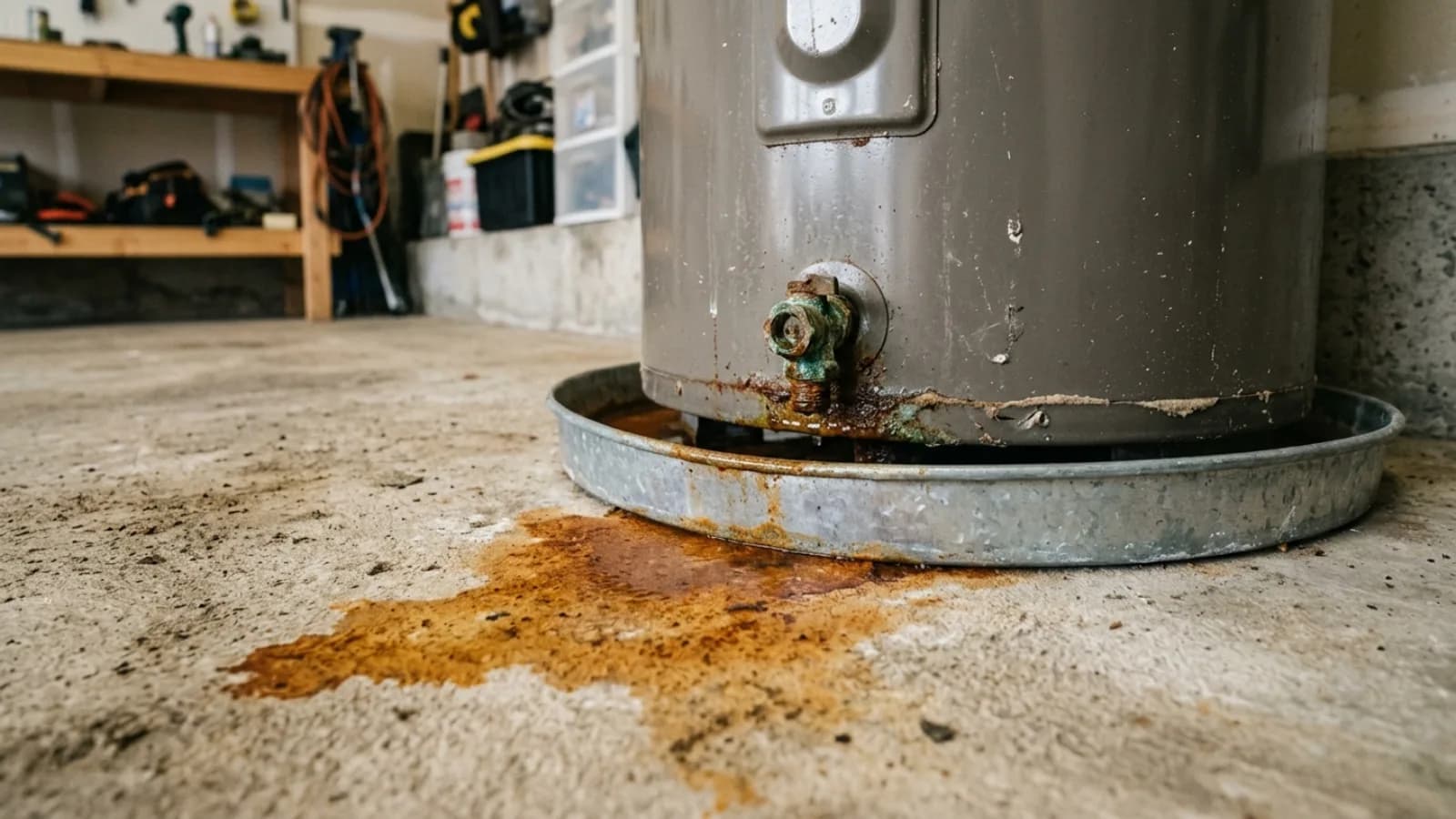
A water heater is an essential part of daily home life — hot water for showers, dishes, and laundry are basic comforts that most families never think about until they disappear. The problem is that water heaters fail quietly. Most homeowners discover an issue only when the unit stops working, or when they walk into a garage and find water pooling around the base. Knowing the warning signs allows you to plan a replacement before a sudden breakdown or leak causes water damage — and gives you time to evaluate your options rather than making a rushed decision under pressure.
Age: The First Indicator
Most traditional tank water heaters last 10 to 15 years. Tankless units typically last 20 years or more with proper maintenance. If a tank heater is approaching or has exceeded 10 years, it is worth evaluating even if it appears to be functioning normally — older units lose efficiency as insulation degrades and internal components wear, and the cost of the next repair may not be worth paying on a unit near end of life.
To find a tank heater’s age, check the manufacturer’s label on the side of the unit. Most include an installation date or a serial number that encodes the manufacture year. If the installation date is not listed and the serial number format is unfamiliar, the manufacturer’s website typically provides a decoder. Keeping this information on file — along with the model number — makes any future service call faster and more efficient.
Rusty Water and Visible Corrosion
If hot water from the tap appears discolored — yellow, orange, or brownish — or carries a metallic smell, the interior of the tank may be rusting. A quick test helps isolate the source: run only the cold water for a minute. If the discoloration appears only on the hot side, the water heater is the likely cause rather than the supply line or a pipe elsewhere in the home.
Rust on the tank’s exterior — particularly around the temperature and pressure relief (T&P) valve, the water supply connections, or the drain valve — suggests internal corrosion has progressed to the point where structural integrity of the tank is at risk. Once rust compromises the tank walls, a leak is likely, and replacement is the only reliable path forward. An anode rod can protect a tank from corrosion earlier in its life, but a heavily rusted tank cannot be restored.
Rumbling Sounds and Sediment
Rumbling, banging, or popping sounds during heat-up cycles are a clear sign of heavy sediment accumulation at the bottom of the tank — a common problem across Temecula, Murrieta, Menifee, and the rest of Riverside County, where hard water leaves mineral deposits faster than in softer-water regions. As the heating element or burner warms water beneath the sediment layer, pockets of trapped water boil and force their way through — creating the noise. Sediment also reduces efficiency, forces the heater to work harder, and accelerates internal wear.
Annual tank flushing helps prevent heavy sediment buildup. If sounds return quickly after a flush, or if an older unit shows persistent noise despite maintenance, the sediment has likely hardened and the unit is nearing the end of its practical life. A professional can assess whether descaling is viable or whether replacement is the better investment. For tank heater maintenance steps, see our complete tank water heater maintenance guide.
Insufficient or Inconsistent Hot Water
Running out of hot water faster than you used to, experiencing temperature swings during a shower, or getting lukewarm water even on a low-demand day all signal that the heating system is struggling. In electric heaters, a failed lower element is a common cause — only the upper element heats, cutting effective capacity roughly in half. In gas heaters, a weakened burner or failing gas control valve reduces heating power and slows recovery time.
Options include repairing specific components — which makes sense on a newer unit — flushing the tank, upsizing to a larger capacity tank, or switching to a tankless system that heats water on demand without capacity limits. Repairing parts on a heater that is already 12 or more years old is rarely the best long-term value. For a full comparison of tank and tankless systems, see our post on tankless vs. tank water heaters.
Leaks and Moisture at the Base
Even a small amount of moisture around the base of the water heater should not be dismissed as normal condensation. Small leaks from fittings, the T&P valve, or supply connections can often be repaired. But if the leak originates from the tank body itself — a crack in the steel — replacement is the only option. A cracked tank will not improve; it will fail more significantly over time.
If you notice active leaking, call immediately. Every minute of running water increases damage to the surrounding area, flooring, and walls. Gardner Plumbing Co. technicians use electronic leak locating and thermal imaging to document and diagnose the situation quickly, presenting options and a recommendation before any work begins. Same-day water heater replacement is available in many cases throughout Riverside County. The U.S. Department of Energy recommends replacing water heaters before they fail completely to avoid emergency costs and water damage.
Rising Energy Bills and Frequent Repairs
A water heater that costs noticeably more to run month over month — without a change in household usage — is losing efficiency. As internal insulation degrades and components wear, older units use more gas or electricity to heat the same volume of water. Newer units carry significantly better energy ratings (UEF — Uniform Energy Factor) than units installed 12 or more years ago.
If a heater has required professional attention two or more times in the past year, the cost of ongoing repairs is often approaching or exceeding the investment in a new unit. Frequent failures point to a system near end of life, and continuing to patch individual components is rarely the smart financial call. Gardner Plumbing Co. presents all options — component repair, full tank replacement, or upgrade to tankless — with honest pros and cons and a professional recommendation. Financing is available for qualifying projects. The company is licensed under CSLB #1073177, handles all permit requirements in California, and installs required accessories including seismic straps, expansion tanks, and drain pans.
Water heater showing warning signs? Call (951) 246-4337 — no trip fees, no obligation. Gardner Plumbing Co. serves Temecula, Murrieta, Menifee, Lake Elsinore, Hemet, Corona, and 20+ additional cities across Riverside County.
Replace Before It Fails You
The worst time to replace a water heater is when it has already failed and is flooding the garage. Watching for the warning signs — age, rust, sediment noise, temperature problems, visible moisture, and rising energy costs — allows a planned replacement on your timeline, with time to evaluate tank versus tankless options and choose the right unit for your household. Gardner Plumbing Co. has served Riverside County homeowners for 30+ years and brings the diagnostic tools, permit experience, and straightforward pricing to make that decision as easy as possible.