Plumbing Basics
Water Pressure Regulators: Why Every Riverside County Home Needs One
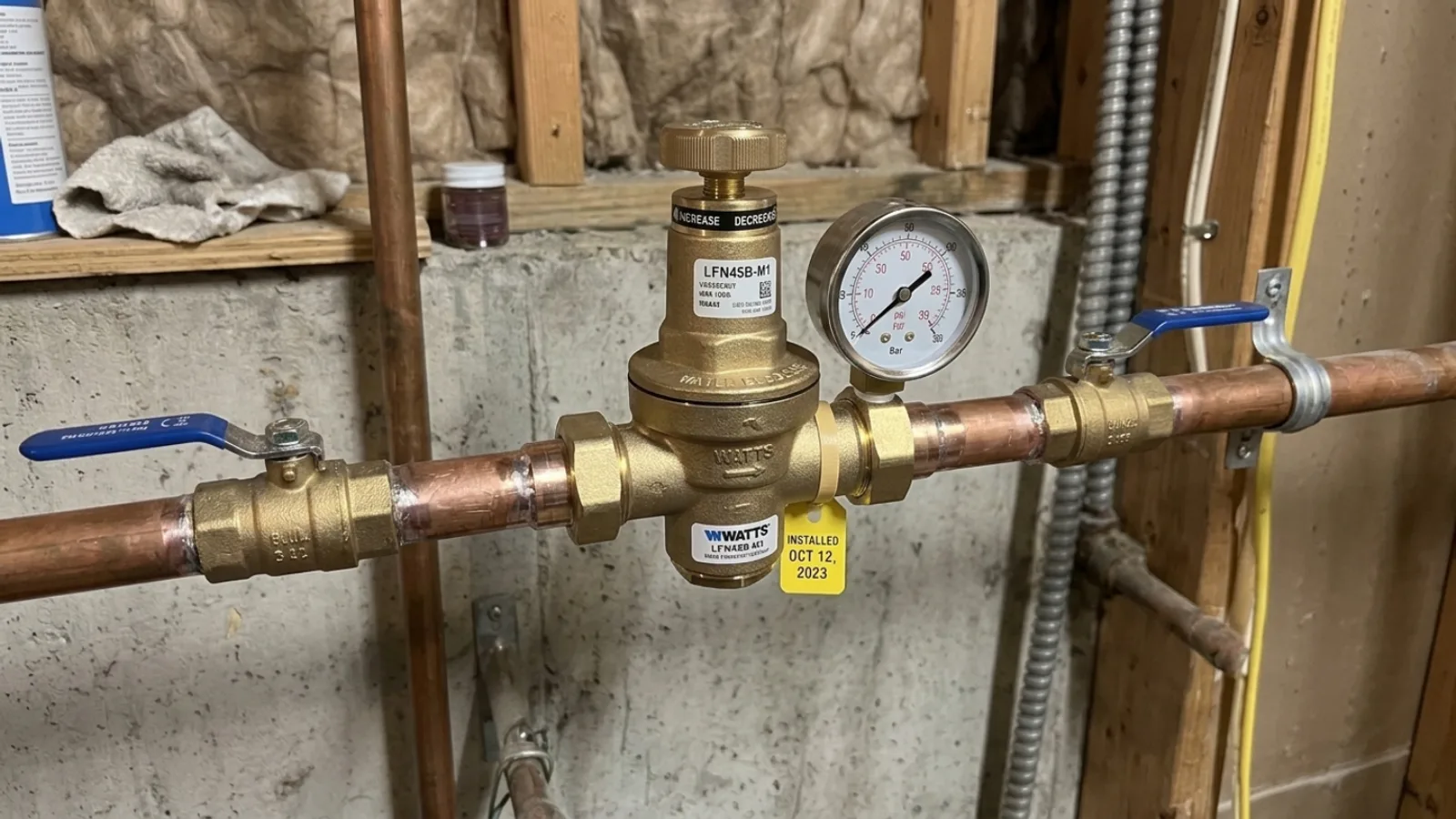
Water pressure is one of the least-checked variables in residential plumbing — and one of the most consequential. While low pressure is an obvious frustration, excessively high pressure is a quiet threat that can accelerate wear on every pipe, joint, valve, and appliance in the home without producing any obvious symptom until something fails. For homeowners in Riverside County — where municipal supply pressure can vary widely across zones in Temecula, Murrieta, Menifee, Lake Elsinore, Hemet, and Corona — understanding water pressure regulators is a practical step toward protecting a significant investment.
What a Pressure Reducing Valve Does
A pressure reducing valve (PRV), sometimes called a water pressure regulator, is a bell-shaped brass device installed on the main water line just after the main shutoff valve. Its function is straightforward: it reduces the pressure of water coming from the municipal supply — which can exceed 100 PSI in some Riverside County zones — to a safe, consistent level before it enters the home's pipes and fixtures. The California Plumbing Code establishes 80 PSI as the maximum recommended static pressure for residential systems and calls for a pressure-reducing device when that threshold is exceeded. The ideal operating range for most residential plumbing is 55–75 PSI. Inside the PRV, a spring and flexible diaphragm respond to downstream pressure in real time, continuously balancing supply fluctuations to maintain a consistent outlet pressure. The adjustment screw on top allows a plumber to fine-tune the set point for the home's specific conditions.
What High Pressure Does to a Home
When water enters a home at excessive pressure, it stresses every component in the system — often in ways that are not visible until a fitting fails, an appliance leaks, or a pipe develops a pinhole. The damage accumulates over years: joints and fittings weaken, rubber washers and O-rings in faucets and valves wear out faster than their design life, and appliance hoses — on washing machines, dishwashers, and refrigerator ice makers — are stressed beyond their rated pressure. In Riverside County homes with copper supply lines or older galvanized piping, high pressure also accelerates the pinhole leak formation that leads to slab leaks and wall-cavity water damage. A related issue is water hammer — the loud banging that occurs when a high-pressure water column stops suddenly when a valve closes. Water hammer can loosen pipe supports and fittings over time and is a direct sign that operating pressure is too high for the system's design. For homes that have experienced unexplained pinhole leaks or recurring fitting failures, a pressure check is a logical first diagnostic step before any repair. See our guide on water pressure problems and solutions for the broader diagnostic picture.
How to Test Home Water Pressure
Testing residential water pressure requires a basic pressure gauge — available at any hardware store for under $20 — attached to an outdoor hose bib. The test should be run first with no water running anywhere in the home (static pressure) and then with a fixture running (dynamic pressure). A gauge with a tattle-tale hand records peak pressure overnight, which is when municipal supply pressure typically spikes as neighborhood demand drops. If static pressure consistently reads above 80 PSI, a PRV should be installed or the existing one evaluated. If the reading fluctuates widely over the course of a day, the PRV may be worn and no longer maintaining consistent output. The International Association of Plumbing and Mechanical Officials (IAPMO) recognizes pressure control as a fundamental component of safe residential plumbing installation.
The PRV and Thermal Expansion
Once a PRV is installed, the home's water system acts as a closed loop — water entering the system has no path to expand back toward the street. This becomes relevant when water heats up: a tank water heater warming 50 gallons of cold water to 120°F causes that volume to expand by roughly one gallon. Without a thermal expansion tank to absorb that volume, the pressure rises inside the closed system and the water heater's temperature and pressure relief valve may drip or open to discharge the excess. A properly specified expansion tank — installed near the water heater — prevents this from happening. Most water heater replacements in California require a permit and must meet current code requirements for expansion tanks on closed systems; a licensed contractor confirms what is required for the specific installation. For more on water heater maintenance and protection, see our guide on tank water heater maintenance.
PRV Lifespan, Warning Signs, and Repair Options
PRVs typically last 10–15 years under normal residential use, but hard water accelerates wear on the internal diaphragm and spring — a known issue in Riverside County's mineral-heavy water supply. When a PRV begins to fail, it may pass higher pressure than its set point, allow pressure to fluctuate unpredictably, or restrict flow and cause low-pressure complaints at fixtures. Warning signs include sudden changes in fixture pressure, intermittent strong and weak flow, increased water hammer, and unexplained increases in the water bill. The water heater's relief valve discharging water is a direct sign that system pressure is climbing beyond safe limits. When a PRV shows these signs, options include adjusting the set screw if the valve is otherwise functional, rebuilding the valve with new internal parts if components are available, or replacing the PRV entirely with a modern unit. Gardner Plumbing Co. presents each option with pros, cons, and a professional recommendation based on the valve's age, condition, and the home's specific pressure profile. For homes with aging supply pipes that have been operating at high pressure for years, a broader pipe condition assessment often accompanies the PRV evaluation.
Special Considerations for Irrigation and Multi-Story Homes
Landscape irrigation systems often perform best at pressures lower than the house setting — sprinkler heads and rotors typically operate at 40–50 PSI, while drip lines work best at 25–30 PSI. Even with a properly set house PRV, irrigation zones may benefit from dedicated pressure-regulating heads or zone regulators for consistent performance and to prevent blown fittings. In multi-story homes, the main PRV is typically set near 60–65 PSI to ensure adequate pressure at second-floor fixtures while protecting lower-level fittings from over-pressure. Gardner Plumbing Co. evaluates whole-home pressure management, including irrigation, during a diagnostic visit and provides upfront flat-rate pricing for all recommended work. CSLB #1073177.
Concerned about your home's water pressure? Call (951) 246-4337 — no trip fees, no obligation. Gardner Plumbing Co. tests pressure, installs and replaces PRVs, and provides full leak detection across Temecula, Murrieta, Menifee, Lake Elsinore, Hemet, and 20+ Riverside County cities.