Water Heaters
Heat Pump vs. Gas vs. Electric Water Heaters
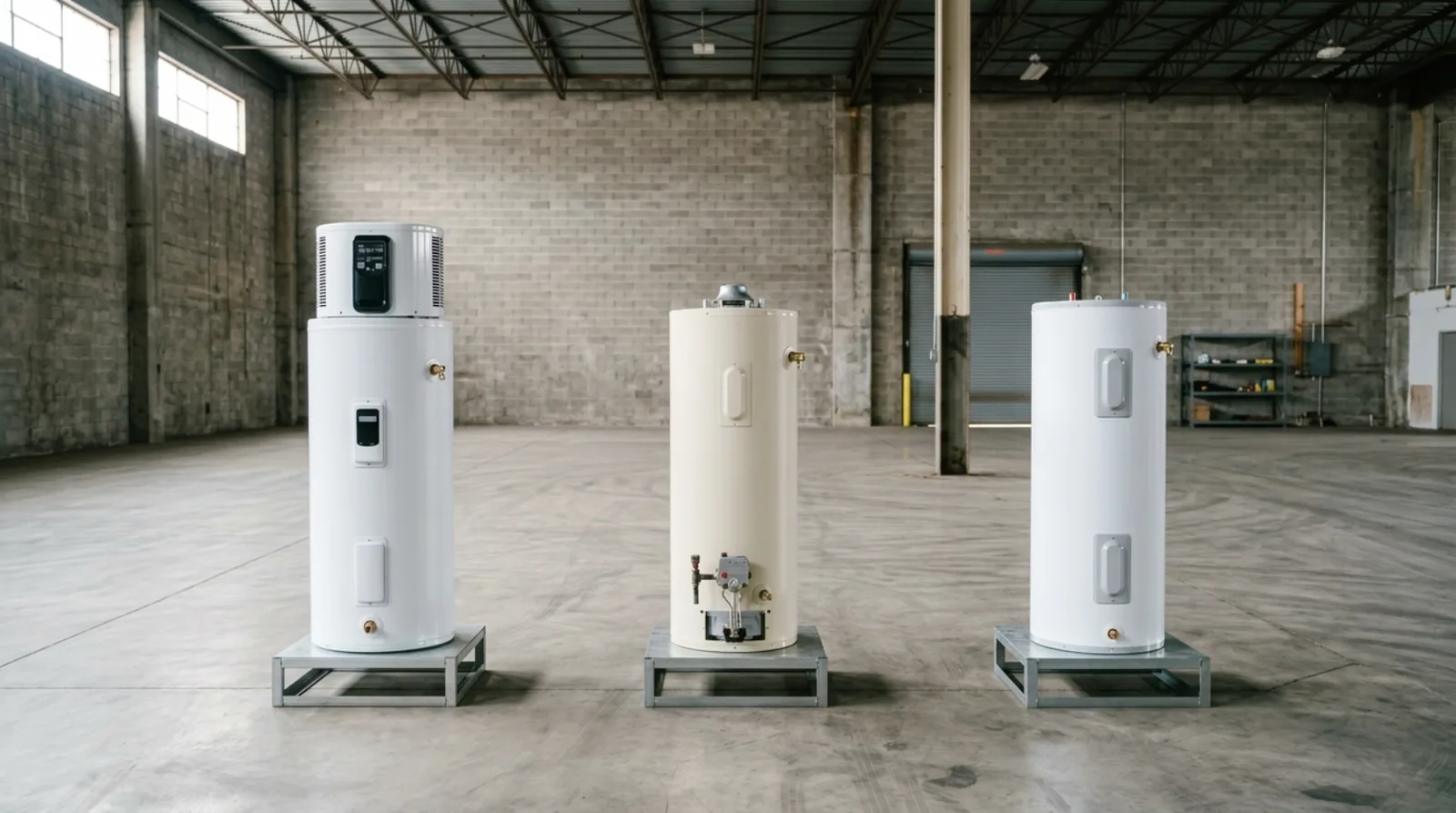
For thirty years the water heater decision in Riverside County was simple: if the house had gas, you installed gas. That default is shifting. Heat pump water heaters have moved from a niche product to a mainstream option, California incentive programs are actively subsidizing them, and new construction is increasingly built for electric water heating. For a homeowner replacing a unit today, the question is genuinely three-sided — gas, standard electric, or heat pump — and the right answer depends on where the unit lives, what your utility rates look like, and how long you plan to stay.
How a Heat Pump Water Heater Actually Works
A conventional electric water heater converts electricity directly into heat through resistance elements. It is roughly 100 percent efficient at that conversion and cannot be better than that, because it is making heat from scratch.
A heat pump water heater does something different: it moves heat rather than creating it. A compressor and refrigerant loop pull thermal energy out of the surrounding air and transfer it into the tank — the same physics as an air conditioner, running in reverse. Because it is relocating existing heat instead of generating new heat, it delivers several units of heat energy per unit of electricity consumed. ENERGY STAR's heat pump water heater resources document the efficiency ratings and qualifying models.
Most units are hybrids: they run in heat pump mode normally and switch on backup resistance elements during heavy demand, so recovery does not fall behind during a busy morning.
Where Each Type Makes Sense
Gas storage remains the fastest-recovering, lowest-operating-cost option in homes where natural gas is already at the unit and the venting is in place. It works during a power outage on older atmospheric-vent designs, recovers quickly, and the replacement is straightforward because the infrastructure exists. It is the practical default for most Riverside County garages today.
Standard electric makes sense where there is no gas at the location, where a unit sits in a tight interior closet with no air volume, or where the lowest upfront cost matters most. It is simple, compact, and inexpensive to install. It is also the most expensive of the three to operate in most rate structures.
Heat pump is compelling where the unit sits in a garage or utility space with enough air volume, where the household wants to reduce gas usage, and where incentives are available. In the Inland Empire it has a genuine bonus: the unit exhausts cool, dehumidified air. In a Murrieta or Menifee garage in August, that is a small side benefit rather than the liability it would be in a cold-climate basement.
The Requirements That Decide Feasibility
Heat pump water heaters carry installation constraints a tank swap does not, and these determine whether one can go in at all:
- Air volume — manufacturers specify a minimum room volume, typically around 700–1,000 cubic feet, or louvered/ducted air. A sealed closet will not work without modification
- Electrical capacity — most units need a dedicated 240-volt circuit; if the home currently has a gas heater, that circuit does not exist and a panel with available capacity is required
- Condensate drain — the unit dehumidifies as it runs and must drain that water to an approved location
- Height and clearance — heat pump units are taller than equivalent tanks and need clearance above for the compressor housing
- Noise — the compressor runs at roughly refrigerator-to-window-AC volume, which is a non-issue in a garage and a real consideration next to a bedroom wall
Where a panel upgrade is needed to add the 240-volt circuit, that changes the project economics substantially — it is an electrical scope on top of a plumbing scope, and it should appear as its own line on the estimate.
California Incentives Change the Math
California has been actively funding the shift to heat pump water heating. TECH Clean California, the statewide initiative supporting heat pump adoption, publishes current incentive availability, and utilities and regional programs layer additional rebates on top. Federal tax credits for qualifying high-efficiency water heaters may also apply.
Incentive programs change — amounts shift, funds run out, eligibility rules get revised. Check current availability before assuming a figure, and confirm whether an incentive requires a participating contractor or specific documentation at installation. The upfront gap between a heat pump unit and a standard tank narrows considerably when incentives apply, and that gap is the entire decision for most households.
Operating Cost Over Ten Years
Upfront price ranks: standard electric lowest, gas in the middle, heat pump highest. Operating cost ranks close to the inverse: heat pump lowest, gas next, standard electric highest. Which one wins over the unit's life depends on your electricity rate, your gas rate, your household's hot water volume, and whether you captured an incentive.
Two local factors tilt the analysis. First, Inland Empire incoming water is relatively warm much of the year, so less energy is required for the same temperature rise — that reduces absolute operating cost for every type but compresses the dollar gap between them. Second, households with solar production may find electric water heating economically attractive in a way gas cannot match, since the marginal cost of daytime electricity is different. Rate structure matters as much as unit efficiency.
A Straight Recommendation
If your existing gas unit failed, gas is already plumbed and vented, and you want the simplest, fastest replacement with fast recovery: install gas. It is not the wrong choice and it will serve you well.
If the unit sits in a garage with room to breathe, the panel has capacity for a 240-volt circuit, you plan to stay in the home eight years or more, and incentives are available: a heat pump water heater is very likely the better long-run decision.
If the unit is in a tight interior closet with no gas and no practical way to add air volume: standard electric, or a tankless electric at the point of use, is the realistic option.
Whichever you choose, size it to the household rather than to the old label — our guide on what size water heater your home needs explains why first hour rating beats gallon capacity. And every replacement in California is permitted work with specific code requirements, covered in our post on water heater permits and code. If you are also weighing tankless, the tankless vs. tank comparison completes the picture.
Gardner Plumbing Co. installs gas, electric, heat pump, and tankless water heaters across Riverside County, quotes the realistic options for your specific location, and handles permitting and inspection. CSLB #1073177, 30+ years local, 900+ five-star Google reviews.
Comparing water heater types for your home? Call (951) 246-4337 for a free in-home water heater consultation — realistic options for your space, written estimate before work begins. Serving Murrieta, Temecula, Menifee, Corona, Riverside, Hemet, and neighboring communities.