Water Heaters
What Size Water Heater Does Your Home Need?
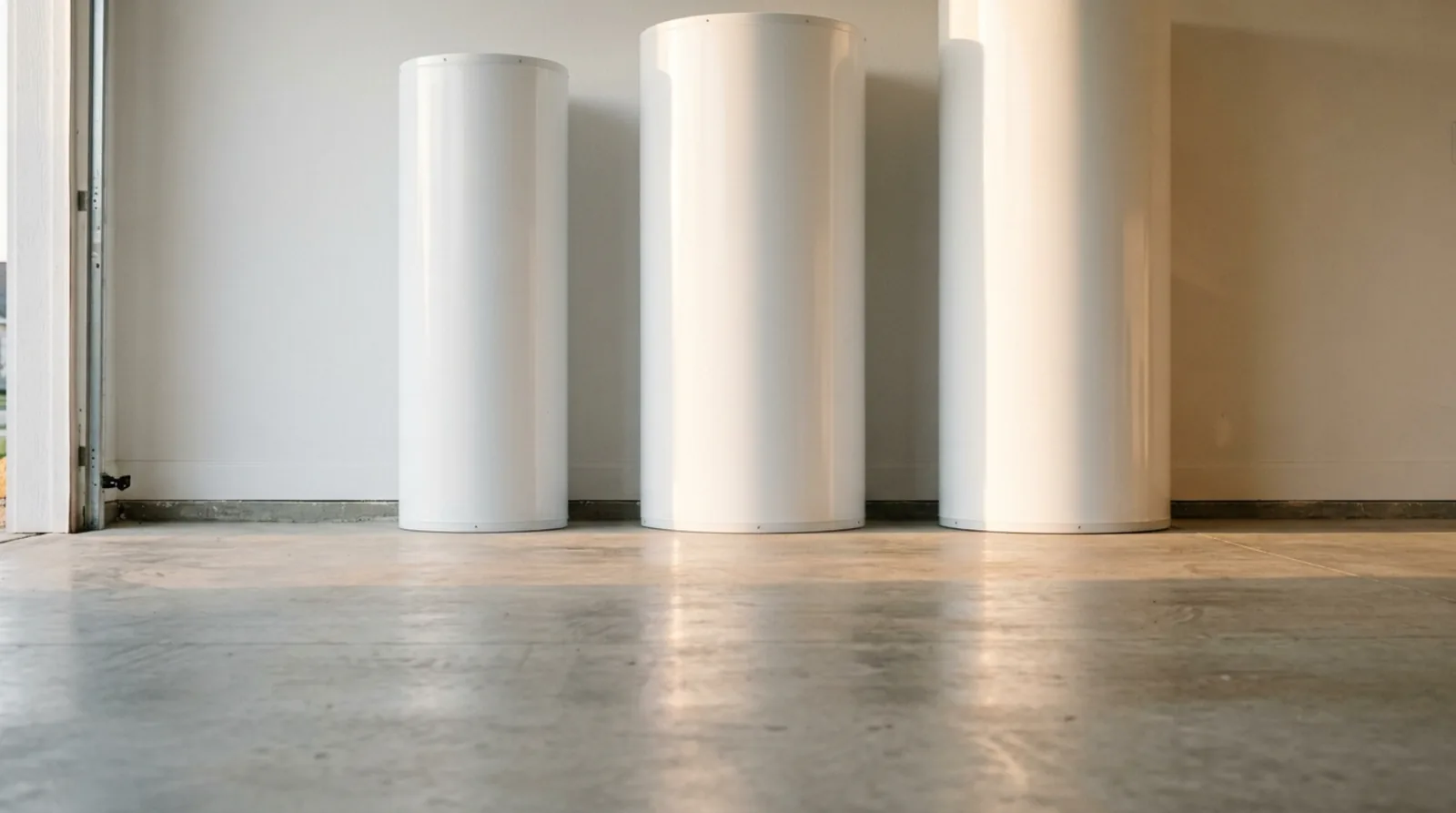
Most homeowners replacing a water heater shop by one number: the gallons on the label. A 40 becomes a 40, a 50 becomes a 50, and the decision feels made. It is the wrong number. Two 50-gallon tanks from different manufacturers can deliver dramatically different amounts of hot water in the hour you actually need it, and a correctly matched 40 can outperform an undersized-in-practice 50. The number that matters is first hour rating, and matching it to your household's peak hour demand is the difference between a water heater that works and one you resent for a decade.
First Hour Rating: The Number That Actually Matters
First hour rating (FHR) is how many gallons of hot water a unit can deliver in one hour starting from a full tank. It combines three things: tank capacity, how fast the burner or element recovers, and how well the tank keeps hot water stratified at the top. A 50-gallon gas unit with a strong burner might carry an FHR near 80 gallons. A 50-gallon electric unit with standard elements might land closer to 60. Same label, very different shower.
FHR appears on the yellow EnergyGuide label in the upper left as "Capacity (first hour rating)." ENERGY STAR's residential water heater criteria define first hour rating as the maximum volume of hot water a storage unit can supply in an hour starting fully heated, and set minimum FHR thresholds that qualifying models have to meet. For tankless units the equivalent number is not FHR at all — it is gallons per minute at a given temperature rise, which is a different sizing exercise entirely.
Calculating Your Peak Hour Demand
Peak hour demand is the single busiest hot-water hour in your day — usually a weekday morning. Walk through that hour and add it up using typical figures:
- Shower: 10–20 gallons each
- Bath: about 20 gallons
- Shaving at the sink: about 2 gallons
- Hand and face washing: about 2 gallons
- Dishwasher cycle: about 6 gallons
- Hand-washing dishes: about 4 gallons
- Clothes washer on hot: about 7 gallons
A household of four where three people shower between 6:30 and 7:30 AM, one load of laundry runs, and the dishwasher starts lands somewhere around 55 to 70 gallons of demand in that hour. You want a unit whose FHR sits within a gallon or two of that number — not the gallon capacity, the FHR. Undersize it and you get the problem described in our post on why hot water runs out too fast. Oversize it substantially and you pay to keep water hot that nobody uses.
Why Riverside County Incoming Water Temperature Helps You
Sizing math depends on temperature rise — how many degrees the unit must lift incoming cold water to reach the setpoint. Inland Empire water arrives warmer than in most of the country for much of the year, often in the 60s to low 70s Fahrenheit through summer. A unit heating from 68°F to 120°F is doing far less work than one heating from 45°F in a colder climate.
That works in your favor on recovery rate and matters enormously for tankless sizing, where output in gallons per minute is stated at a specific rise. It also means winter and summer behave differently — a tankless unit that comfortably runs two showers in August may only manage one and a half in January when incoming water drops. Size for the coldest month, not the average.
Five Sizing Mistakes That Cost Homeowners Years of Frustration
Replacing like for like without asking why. The existing unit was sized for whoever lived there in the year it was installed. If the household grew, added a bathroom, or installed a soaking tub, the old size is a starting point, not an answer.
Sizing for the house instead of the schedule. A five-bedroom home where two people live and shower at different times needs less capacity than a three-bedroom where five people leave at the same time. Occupancy pattern beats square footage.
Ignoring fixture flow rates. A rain showerhead at 2.5 gallons per minute burns capacity roughly 40 percent faster than a 1.8 GPM head. Two of them running at once changes the sizing category outright.
Forgetting the recirculation loop. Homes with a hot water recirculation system lose standby heat continuously and place ongoing demand on the unit. That has to be accounted for in the sizing, not discovered afterward.
Assuming bigger is safer. An oversized tank has higher standby losses every hour of every day, and in a tight garage alcove a larger-diameter unit may not physically fit with the clearances code requires.
Tank or Tankless Changes the Question Entirely
With a tank, you are sizing a reservoir: how much stored hot water do you need in one hour. With tankless, there is no reservoir — you are sizing simultaneous flow: how many fixtures need hot water at the same moment, and at what temperature rise. A household that needs a 65-gallon FHR tank might need a tankless unit rated around 7 to 8 GPM at winter rise to serve two showers and a sink concurrently.
Tankless also brings gas line and venting requirements a tank replacement usually does not — many units need a larger gas supply line than the one feeding the old tank. Our comparison of tankless vs. tank water heaters covers the full tradeoff, and the tankless upgrade guide addresses the Temecula-area specifics.
Get the Sizing Done Before the Old Unit Fails
The worst time to size a water heater is the morning it is leaking across the garage floor and everyone wants hot water back by dinner. That is how homes end up with whatever happened to be on the truck. Knowing your peak hour demand and target FHR before the failure means the replacement is a decision instead of a reaction — and the warning signs a water heater is near end of life usually give you months of notice.
Gardner Plumbing Co. sizes every replacement to the household rather than the label, including a check of gas line capacity, venting, seismic strapping, expansion tank requirements, and available clearances before the quote is written. Licensed under CSLB #1073177 with 30+ years serving Riverside County and 900+ five-star Google reviews. Staying on top of annual tank maintenance is what makes a correctly sized unit last its full service life.
Replacing a water heater and want it sized right? Call (951) 246-4337 for a free in-home water heater assessment — written estimate before work begins, no trip fees. Serving Murrieta, Temecula, Menifee, Hemet, Riverside, and neighboring communities.