Water Heaters
Water Heater Replacement Permits and Code in California
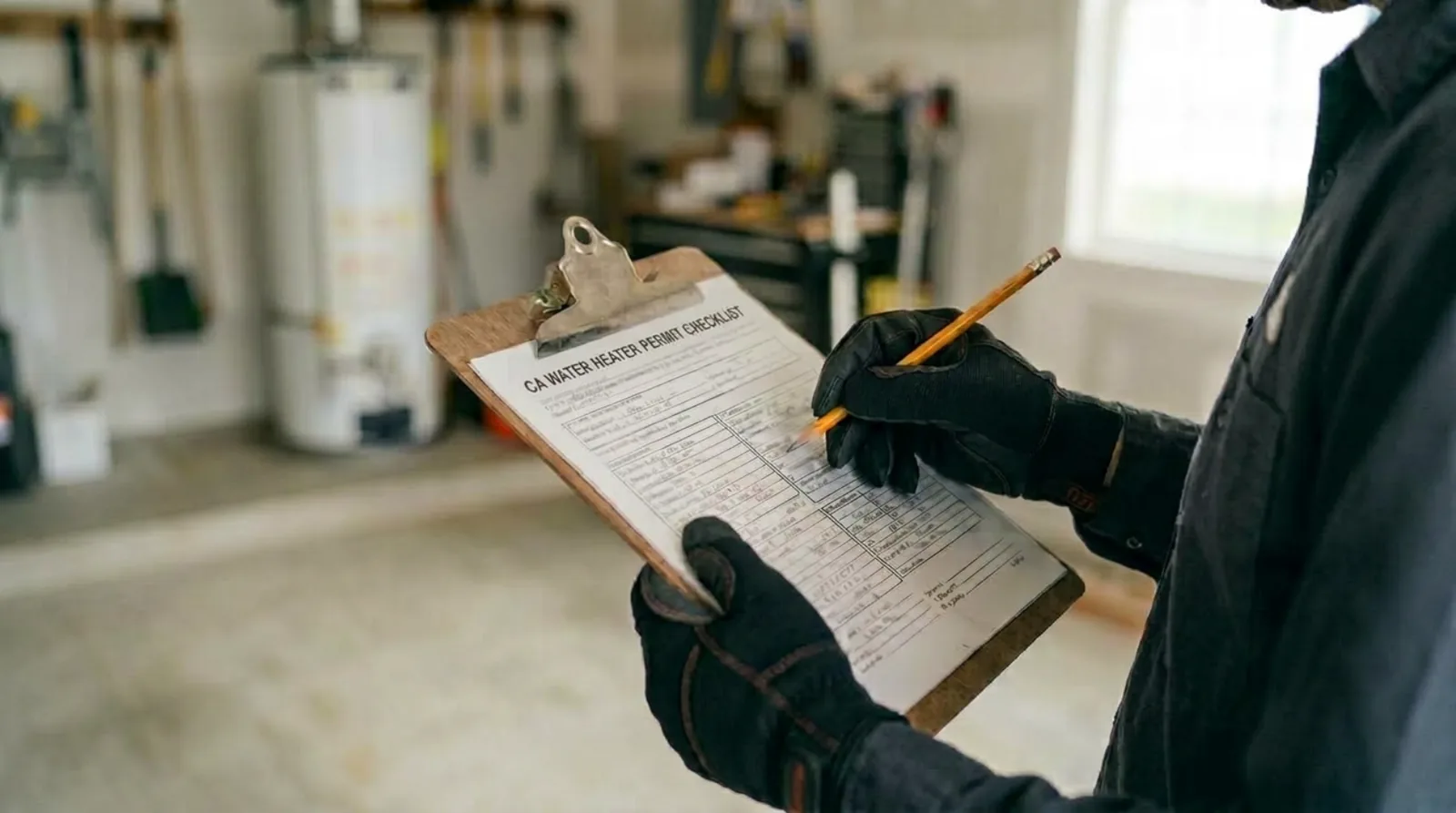
A water heater replacement looks like the simplest job in plumbing: disconnect the old unit, set the new one, reconnect, done in an afternoon. In California it is not that, and the difference is not paperwork for its own sake. State code treats a water heater as a pressure vessel with a gas appliance attached, sitting in a seismic zone, usually inside a garage or a closet inside the living space. The requirements that follow — strapping, expansion control, pans, venting, combustion air, and a permit with an inspection — exist because each one addresses a documented failure mode. Here is what a code-compliant replacement in Riverside County actually involves.
Yes, a Permit Is Required
Replacing a water heater is permitted work in California jurisdictions. The California Building Standards Commission publishes the Title 24 California Building Standards Code, which includes the California Plumbing and Mechanical Codes that local building departments enforce. Energy-related provisions come through the California Energy Commission's Building Energy Efficiency Standards, which govern efficiency requirements and pipe insulation on replacements.
A licensed contractor pulls the permit, and the jurisdiction inspects the installation. For homeowners, the inspection is free third-party verification that the appliance in the garage was installed correctly — and the permit record is what a buyer's inspector or an insurance adjuster looks for later. An unpermitted water heater is a disclosure item at resale.
Seismic Strapping: Two Straps, Specific Placement
California requires water heaters to be braced against earthquake movement. The standard is two straps — one in the upper third of the tank and one in the lower third, with the lower strap positioned a minimum distance above the controls — anchored into structural framing, not just drywall.
A tank that walks off its base in a quake shears the gas line and the water connections simultaneously. That is the failure this addresses. Plumber's tape wrapped around a tank is not compliant strapping, and it is one of the most common findings when an inspector looks at older work in Inland Empire garages.
Expansion Tanks and Closed Systems
When water heats, it expands. In an open system, that expansion pushed back into the municipal main. Nearly every home in Riverside County is now a closed system, because a pressure regulator or a backflow device at the meter prevents water from flowing backward. In a closed system, thermal expansion has nowhere to go, so pressure inside the tank rises with every heating cycle.
A thermal expansion tank absorbs that volume. Without one, the excess pressure cycles the temperature and pressure relief valve, stresses fittings and fixture supply lines, shortens the water heater's life, and can produce the intermittent dripping many homeowners mistake for a bad T&P valve. If your home has a pressure regulator or a backflow prevention device, an expansion tank belongs on the system.
Drain Pans and Discharge Routing
Water heaters installed where a leak would damage the structure — attics, upper floors, interior closets over finished space — require a drain pan piped to an approved point of discharge. In garages on slab, the requirement depends on the jurisdiction and the specific location.
Two details get missed constantly. First, the T&P relief valve discharge pipe must run full size, downward, terminate in an approved location, and have no valve, no threading at the end, and no reduction in diameter. Second, the pan drain and the T&P discharge are separate systems and cannot be tied together. Both exist so that a pressure event vents safely rather than into a closed space.
Venting and Combustion Air on Gas Units
Gas water heaters produce carbon monoxide as a combustion byproduct, and the vent is what moves it outside. Code addresses vent sizing, vent material, slope, clearance to combustibles, and the connection into a shared flue where a furnace is also present.
Combustion air is the requirement most often overlooked. An atmospheric-vent water heater needs adequate air volume to burn correctly, which is why enclosing a unit in a tight closet or sealing a garage for energy retrofits can create a problem that did not exist before. A unit starved of combustion air can backdraft — pulling exhaust into the living space instead of out the flue. Also relevant in garages: gas water heaters have ignition source elevation requirements relative to the floor, and units must be protected from vehicle impact where they sit in a drive path.
What Else the Inspector Will Look For
- Insulation on the first several feet of hot and cold piping at the unit
- An accessible shutoff valve on the cold water supply
- A sediment trap (drip leg) on the gas supply line
- An approved gas connector, correctly sized and not spliced
- Dielectric unions or approved connectors where dissimilar metals meet
- Working clearance in front of the unit for service access
- Thermostat set no higher than the code maximum at the time of inspection
A tankless conversion adds more: many tankless units require a larger gas supply line than the one feeding the old tank, a different venting system, and often a condensate drain. That is why a tankless swap is a different project than a tank replacement — covered in our tankless vs. tank comparison.
Why the Unpermitted Swap Costs More in the End
Unpermitted water heater work surfaces at three predictable moments: when the home is sold and an inspector flags it, when an insurance claim follows a failure and the carrier examines the installation, and when a gas issue prompts the utility to red-tag the appliance. In each case the fix is retroactive permitting and correction, usually at higher cost than doing it right the first time — and at the worst possible moment.
It also matters for sizing. A permitted replacement is an opportunity to confirm the unit is actually right for the household rather than repeating whatever was there; our guide to water heater sizing covers how to do that. Gardner Plumbing Co. pulls permits on water heater replacements, installs to current California code, and handles the inspection. CSLB #1073177, 30+ years serving Riverside County, 900+ five-star Google reviews. Ongoing care is covered in our tank water heater maintenance guide.
Water heater failing or overdue for replacement? Call (951) 246-4337 for a free in-home estimate on water heater installation and service — permitted, code-compliant, written price before work begins. Serving Murrieta, Temecula, Menifee, Hemet, Riverside, Corona, and neighboring communities.