Homeowner Tips
What to Expect During a Professional Plumbing Inspection
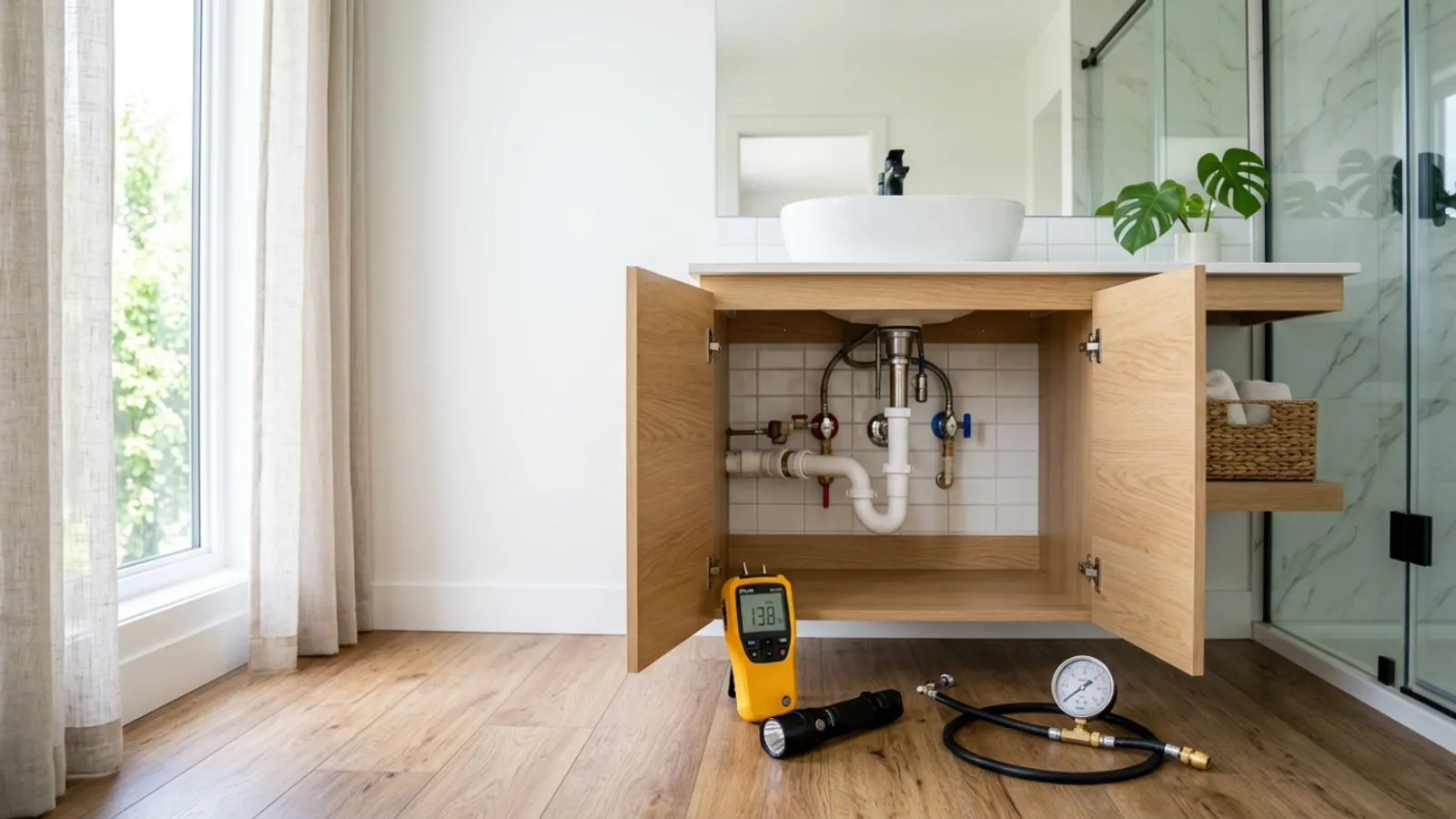
Most homeowners call a plumber when something goes wrong. A professional plumbing inspection inverts that pattern — it finds what is developing before it fails, documents the current condition of every system, and gives the homeowner a prioritized picture of what needs attention now versus what can wait. For residents in Temecula, Murrieta, Menifee, Lake Elsinore, Hemet, and Corona, a routine inspection is also the most cost-effective way to catch slab leaks, aging pipe materials, and sewer line problems before they escalate into emergency repairs. Here is a clear look at what to expect from start to finish.
Before the Inspection: Preparation and Consultation
The process typically begins with a brief consultation at the door. The technician asks about any concerns — slow drains, changes in water pressure, unusual sounds, higher-than-normal water bills, or prior plumbing issues — and notes the home's age and the pipe materials visible at access points. Clearing space under sinks, around the water heater, and near access panels before the appointment allows the technician to work without delays. If the home has a sewer cleanout, pointing out its location saves time during the line assessment. Gardner Plumbing Co. technicians arrive with shoe covers and drop cloths and explain each step of the inspection as they work, so the homeowner understands what they are seeing and why it matters.
Water Heater Evaluation
The water heater receives thorough attention during any professional inspection. The technician checks the unit's age and capacity, examines the exterior for rust, corrosion, or moisture at fittings and the base, and tests the temperature and pressure relief (T&P) valve — a safety device that must be unobstructed and piped to a safe discharge location. On gas units, venting and the gas connection are inspected. The thermostat setting is noted; most California households set tanks near 120°F to balance comfort and scald risk. California code requires seismic strapping on all water heater tanks, and its condition is verified. The presence and condition of an expansion tank — required on closed water systems — is also evaluated. Thermal imaging can detect early corrosion or moisture issues that visual inspection alone may miss. Most water heater replacements in California require permits; if replacement is recommended, Gardner Plumbing Co. handles the applicable permit, code compliance, and final inspection.
Pipes, Valves, and Supply Lines
Every accessible supply line and shutoff valve in the home is examined. This includes lines under kitchen and bathroom sinks, behind toilets, in laundry areas, and at the water heater. The technician looks for moisture, corrosion, mineral scale, kinked hoses, and any sign of active or past leakage. In Riverside County, where concrete slab construction is prevalent across communities like Temecula, Murrieta, and Menifee, the inspection specifically looks for signs of slab leaks: warm spots on floors, running-water sounds with all fixtures off, and unexplained water bill increases. A simple meter test — watching the meter's low-flow indicator with all fixtures and irrigation shut off — confirms or rules out an active hidden leak within minutes. Where non-invasive detection is warranted, electronic leak locating and acoustic equipment pinpoint the source without opening walls. The main shutoff valve is located, operated, and evaluated; stiff or corroded valves are flagged for replacement. Homeowners who want automatic protection can also ask about Moen Flo smart water monitoring, which provides real-time alerts and automatic shutoff capability and may qualify for homeowners insurance discounts.
Fixtures and Drain Performance
Every faucet and shower is tested for hot and cold balance, flow rate, and consistent water pressure. Low flow at a single fixture usually indicates a clogged aerator — common in Riverside County's hard-water environment. Low pressure at every fixture points to a supply-side issue that warrants deeper investigation. Toilets are flushed and observed for a complete refill cycle. A dye test reveals silent tank-to-bowl seepage that wastes hundreds of gallons per month without any visible evidence. Toilet stability is checked at the base to confirm a secure wax ring seal. Under every sink, P-traps are inspected for correct installation, leaks, and adequate trap depth. If gurgling, slow drainage, or sewer odors are present, the vent system is evaluated alongside the drain. Video inspection technology can document internal drain condition where warranted. For more on what professional drain evaluation involves, our guide on hydro-jetting and drain care covers the tools used and when each approach applies.
Sewer Line Camera Assessment
A comprehensive inspection includes a main sewer line assessment using a high-definition video camera inserted through the exterior cleanout. The camera shows tree root intrusion, cracks, offset joints, bellied sections that hold standing water, and scale or grease accumulation that narrows flow capacity. This is one of the highest-value components of a professional inspection because sewer line problems are invisible to surface observation — until a backup occurs. Homeowners receive video documentation of what the camera finds, which supports informed decision-making about whether to clean, repair, or schedule follow-up monitoring. The camera approach is explained in detail in our post on understanding your main sewer cleanout.
Pressure, Water Quality, and Outdoor Systems
System pressure is measured at a hose bib. Readings consistently above 80 PSI indicate the PRV needs evaluation; readings below 50 PSI suggest supply-line restriction or a leak. Outdoor hose bibs are inspected for drips and proper vacuum breakers. Irrigation backflow prevention devices are confirmed present and discussed in terms of testing requirements. Given Riverside County's hard water, the technician discusses water quality options — whole-house filtration, water softening, chloramine removal, and point-of-use reverse osmosis — and can recommend a solution based on the home's specific water characteristics and household needs. Homeowners can also review their local water quality data through the California State Water Resources Control Board. For a full breakdown of how hard water affects fixtures and appliances, see our guide on how water quality affects plumbing.
After the Inspection: Report and Next Steps
Following the inspection, the technician provides a clear report with photos and video clips from any sewer camera work. Findings are organized into immediate repair needs, items to monitor, and recommended upgrades. Where repair options exist, Gardner Plumbing Co. presents each path with pros, cons, and a professional recommendation — so the homeowner makes an informed decision rather than simply agreeing to the first suggestion. All estimates are upfront flat-rate pricing. Financing is available for qualifying projects such as repiping, water heater replacement, or filtration system installation. The full 65-point inspection is Gardner Plumbing Co.'s standard offering for homeowners who want a complete system picture — a smart step before buying a home, after a major renovation, or simply as an annual maintenance baseline. Gardner Plumbing Co. is licensed under CSLB #1073177 and has served Riverside County homeowners for 30+ years, backed by 900+ five-star Google reviews.
Ready to schedule a professional plumbing inspection? Call (951) 246-4337 — no trip fees, no obligation. Gardner Plumbing Co. serves Temecula, Murrieta, Menifee, Lake Elsinore, Hemet, and 20+ additional cities across Riverside County.