Sewer & Septic
Sewer Camera Inspection: What It Shows and When to Get One
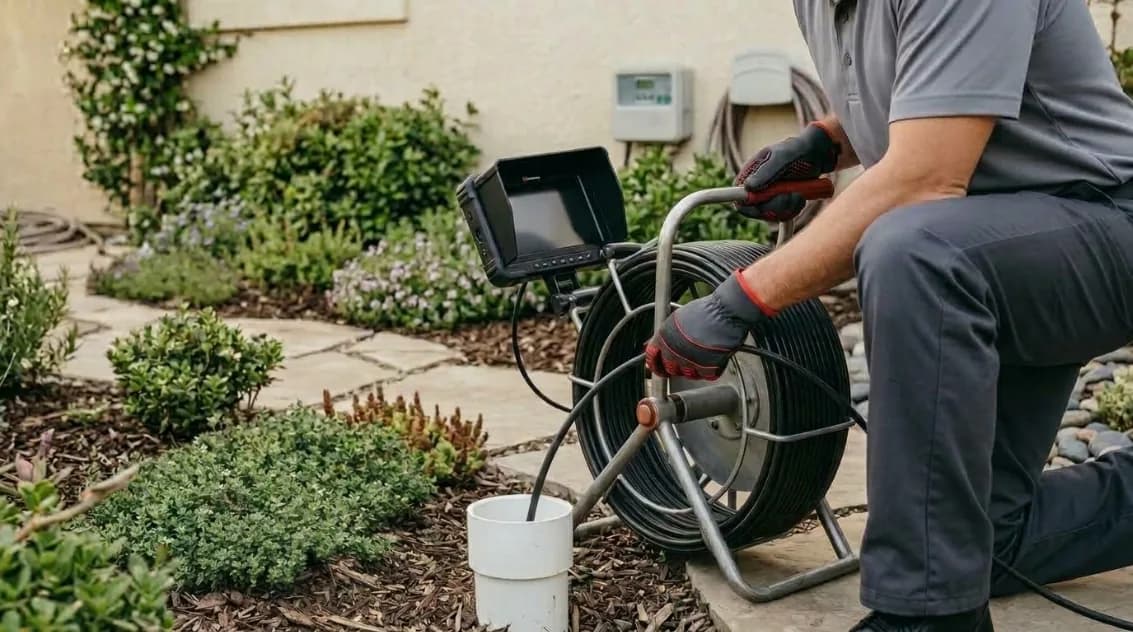
Every recommendation about a sewer line is either based on evidence or based on inference. Without a camera, a plumber is reading symptoms — how fast the line drains, what came back on the cable, how often it clogs — and reasoning backward. With a camera, the pipe is on a screen: the material, the condition, the joints, the intrusions, the standing water, and the precise distance from the access point to the problem. For Riverside County homeowners facing a recurring backup or a major decision about a sewer lateral, that distinction is the difference between an estimate and a guess.
How the Inspection Works
A self-leveling camera head on a flexible push rod enters through the main sewer cleanout — usually a capped pipe outside near the foundation — and travels the line toward the municipal connection. Video comes back in real time. Footage counters mark distance traveled, so any defect can be located to within a foot or two.
Most camera heads carry a sonde, a small transmitter that a locator above ground can track. That lets a technician mark the exact position and depth of a defect on the lawn or driveway — which is what makes a targeted repair possible instead of exploratory digging. The industry's assessment and coding standards come from NASSCO, whose Pipeline Assessment Certification Program defines how pipe conditions are described and graded consistently across the industry.
One practical note: the line should be cleared before it is filmed. A camera pushed into a line full of standing water and debris shows debris. Clearing first, filming second, gives a usable picture of the pipe itself.
Six Things a Camera Actually Finds
Root intrusion. Roots enter at joints and cracks, then grow into a mass that catches paper and solids. On camera they appear as fine white filaments or a dense mat. Crucially, the camera shows whether the roots entered through a hairline joint gap or through a structural crack — the first is manageable with maintenance, the second means the pipe is failing. Our post on tree root intrusion covers the biology behind it.
Bellies and sags. A section that has settled below grade holds standing water permanently. Solids drop out in the low spot and build until the line blocks. A belly is a grading problem, not a cleaning problem — clearing it restores flow temporarily and the same clog returns on schedule.
Offset joints. Ground movement shifts one pipe section out of alignment with the next, creating a lip that catches everything passing. Common in older clay-tile laterals across established Riverside, Hemet, and Perris neighborhoods.
Cracks, fractures, and collapse. The camera distinguishes a hairline crack from a fracture with displaced pipe wall from a fully collapsed section. Those three findings lead to three very different repair recommendations and three very different prices.
Grease and scale buildup. Interior walls coated to the point that effective diameter is a fraction of nominal. This is the finding that justifies hydro-jetting instead of cable clearing, because jetting restores the full diameter rather than punching a channel through the buildup.
Foreign objects and pipe material. Construction debris, a lost toy, a mass of accumulated wipes. The camera also identifies what the pipe is made of — clay tile, cast iron, Orangeburg, ABS, or PVC — which directly determines remaining service life expectations.
Five Situations Where an Inspection Pays for Itself
- Before buying a home — sewer laterals are typically outside the scope of a standard home inspection, and a failing lateral is one of the largest surprise expenses a buyer can inherit
- After a second backup in twelve months — recurrence means a cause the cable is not addressing
- Before paying for a major repair — never authorize excavation or a liner based on inference alone
- On any home built before roughly 1980 — clay tile and cast iron laterals of that era are at or past design life
- After a sizable tree has been growing near the line for years — even without symptoms yet
For buyers, pairing a camera inspection with a full system review is the complete picture — our guide to plumbing inspections for home buyers covers what else to ask for.
What to Ask For and What to Keep
A camera inspection should leave you with something you can hold onto. Ask for:
- A copy of the video file, not just a verbal summary
- Footage distances for every defect noted
- Identification of the pipe material and approximate age
- A marked location and depth for any defect requiring excavation
- A written recommendation that separates urgent from monitor-and-revisit
That documentation has value beyond the immediate decision. It supports negotiation in a real estate transaction, it establishes a baseline for comparison at the next inspection, and it substantiates an insurance conversation if the line fails later.
Reading the Findings Without Being Pressured
Not every defect on camera is an emergency. Light root filaments at one joint on an otherwise sound line is a maintenance item. A belly holding two inches of water is a known issue to manage, not necessarily an immediate excavation. A fractured section with soil visible through the pipe wall is urgent.
A technician should be able to walk you through the footage, point at the screen, and explain which category each finding falls into. If a recommendation cannot be tied to something visible on the video, ask why. Homeowners evaluating a contractor's approach should also read our post on red flags when hiring a plumbing company.
Gardner Plumbing Co. performs camera inspections on sewer and septic lines throughout Riverside County, shows homeowners the footage on site, and provides written findings with repair options and pricing before any work is authorized. CSLB #1073177, 30+ years local, 900+ five-star Google reviews.
Recurring backups, or buying a home with an older sewer lateral? Call (951) 246-4337 to schedule a camera inspection. Gardner Plumbing Co. serves Temecula, Murrieta, Menifee, Corona, Riverside, Hemet, and 20+ cities across Riverside County and neighboring communities.