Sewer & Septic
Trenchless Sewer Repair: Pipe Lining vs. Pipe Bursting
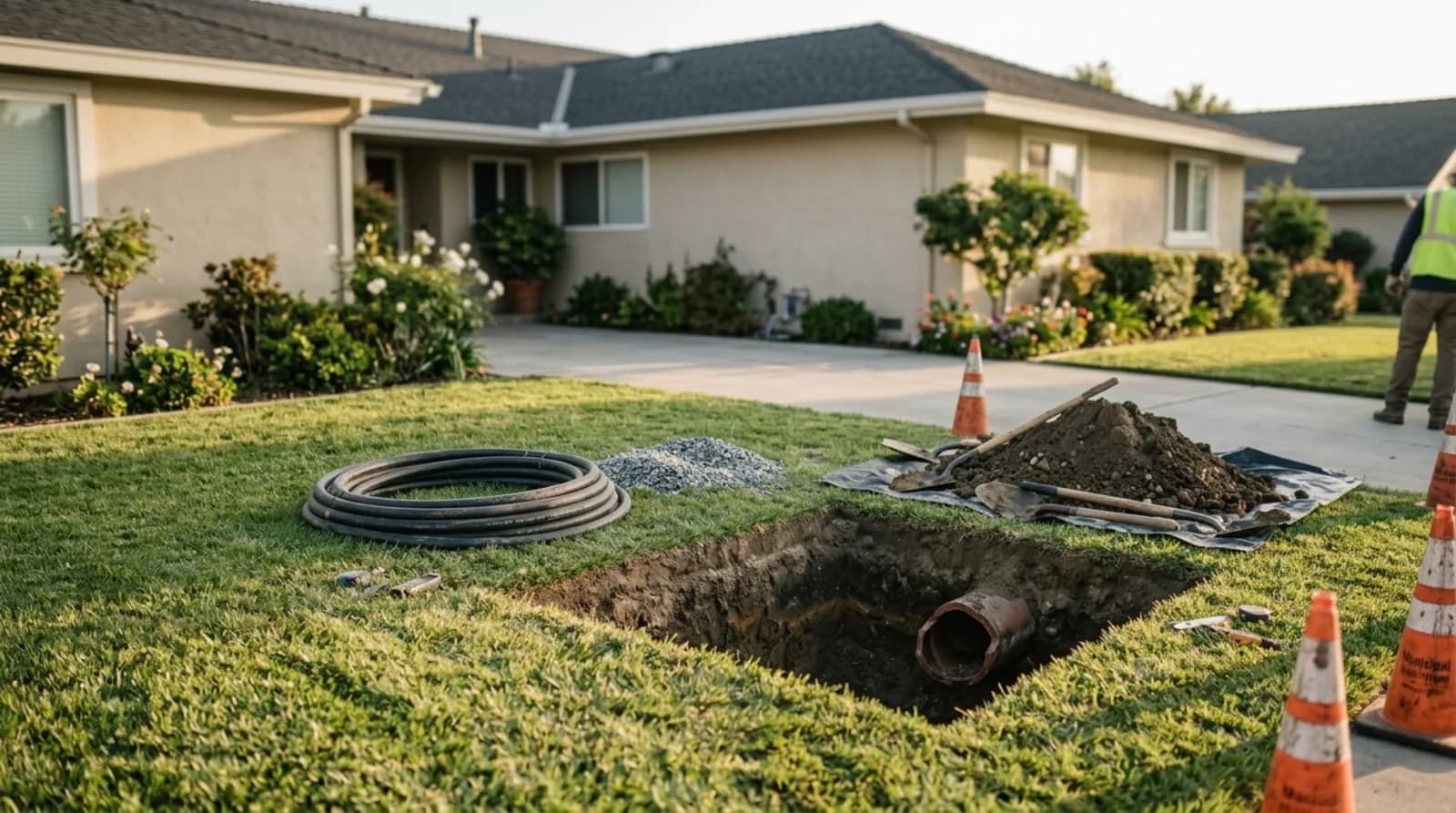
For decades, replacing a failed sewer lateral meant one thing: a trench from the house to the street. Out came the lawn, the driveway section, the mature landscaping, and occasionally the hardscape someone had just installed. Trenchless methods changed that. Two approaches — cured-in-place pipe lining and pipe bursting — can replace or rehabilitate a lateral through access points at each end, leaving most of the yard intact. Neither works in every situation, and a contractor who recommends one without a camera inspection first is selling rather than diagnosing. Here is how each actually works and what determines whether your line qualifies.
Cured-in-Place Pipe Lining (CIPP)
Lining creates a new pipe inside the old one. A flexible tube saturated with resin is pulled or inverted into the cleaned host pipe, inflated so it presses against the interior wall, and then cured — with ambient temperature, heat, steam, or ultraviolet light depending on the system. When the resin hardens, the result is a continuous, jointless structural pipe formed to the shape of the original.
Because it is seamless, a liner eliminates the joints where roots entered in the first place. NASSCO, the National Association of Sewer Service Companies, notes that CIPP has been in use as a trenchless rehabilitation method for over fifty years across pipe diameters from a few inches to well over eight feet.
Lining requires: a host pipe that is structurally continuous enough to hold the liner's shape, no significant collapse, no severe offsets that would prevent the liner from seating, and no belly holding standing water — a liner installed through a sag preserves the sag permanently. It also slightly reduces interior diameter, which is usually immaterial on a residential lateral but matters if the line was already undersized.
Pipe Bursting
Bursting replaces the old pipe entirely. A conical bursting head is pulled through the existing line by a cable winched from a receiving pit. The head fractures the old pipe outward into the surrounding soil while simultaneously pulling a new HDPE pipe in behind it. What you end up with is a brand-new pipe along the original path — not a liner inside an old one.
Bursting handles conditions lining cannot: fully collapsed sections, severely offset joints, and pipe deteriorated past the point of serving as a host. It can also upsize the line — replacing a 4-inch lateral with a 4-inch or larger HDPE pipe — where capacity is a factor.
Bursting requires excavated access pits at both ends, soil that will accept the displaced fragments, and adequate clearance from other buried utilities along the path. Fracturing a pipe outward next to a gas line, a water service, or a fiber conduit is not acceptable, so utility locating is mandatory before the work begins. Cast iron and clay burst readily; some materials do not.
When Open Excavation Is Still the Answer
Trenchless is not universally superior, and an honest contractor will say so. Traditional excavation remains correct when:
- The line has a belly that needs re-grading — no trenchless method fixes slope
- The failure is a short, shallow, easily accessible section where digging is genuinely cheaper
- The lateral path is congested with other utilities at close clearance
- The line needs rerouting rather than replacement in place
- Soil conditions or depth make trenchless access impractical
Cost is situational. Trenchless usually carries a higher per-foot price and a lower total restoration cost. Where the line runs under a lawn that is easy to replace, excavation may come out ahead. Where it runs under a driveway, mature trees, decorative concrete, or a pool deck, trenchless is frequently the cheaper project once restoration is counted — and that is the comparison that matters.
The Camera Inspection Decides, Not the Sales Pitch
No one can responsibly recommend lining or bursting without seeing the inside of the pipe. The inspection establishes pipe material, diameter, defect locations by footage, whether standing water indicates a belly, whether joints are offset, and whether any section has collapsed. Those findings determine which methods are even on the table.
Ask for the video, ask for footage markers on every defect, and ask specifically why the recommended method was chosen over the alternatives. Our guide to sewer camera inspections covers what a thorough one includes, and red flags when hiring a plumbing company covers the pressure tactics worth walking away from on a project this size.
What to Expect During the Work
Both methods are permitted work requiring inspection. Both begin with thorough cleaning of the existing line — typically hydro-jetting plus root cutting — because neither a liner nor a bursting head passes cleanly through a line full of debris.
Expect a short period with the home's sewer service out of commission, usually within a single working day for a residential lateral. Lining requires curing time before the line returns to service. Bursting requires the access pits to be backfilled and compacted, and surface restoration follows. Where the lateral crosses into the public right-of-way, the jurisdiction or the sewer agency may have its own permit and inspection requirements for that segment.
Afterward, ask for post-work camera footage. A line that was worth replacing is worth documenting in its finished condition — that video is your record for warranty, resale, and any future service.
Why This Comes Up in the Inland Empire
Established neighborhoods across Riverside, Hemet, Perris, San Jacinto, and Corona have laterals of clay tile or cast iron that are at or beyond their design life. Clay tile is especially vulnerable at its joints, and decades of mature landscaping means roots have had a long time to find them — the mechanism is detailed in tree root intrusion. Expansive soils across parts of the region also shift pipe over time, producing the offsets and bellies that decide which repair method applies.
Homeowners facing a second or third backup in a year are usually past the point where clearing is the answer — our post on reading drain symptoms explains how to tell. Gardner Plumbing Co. inspects, clears, repairs, and replaces sewer lines across Riverside County, shows homeowners the camera footage before recommending anything, and provides written pricing on every option. CSLB #1073177, 30+ years in business, 900+ five-star Google reviews. Financing is available for qualifying projects.
Facing a sewer lateral replacement? Call (951) 246-4337 to schedule a camera inspection and get every viable repair option in writing. Gardner Plumbing Co. serves Riverside, Corona, Hemet, Perris, San Jacinto, Moreno Valley, Temecula, Murrieta, and 20+ cities across Riverside County and neighboring communities.