Repiping
What Determines the Cost of a Whole-House Repipe
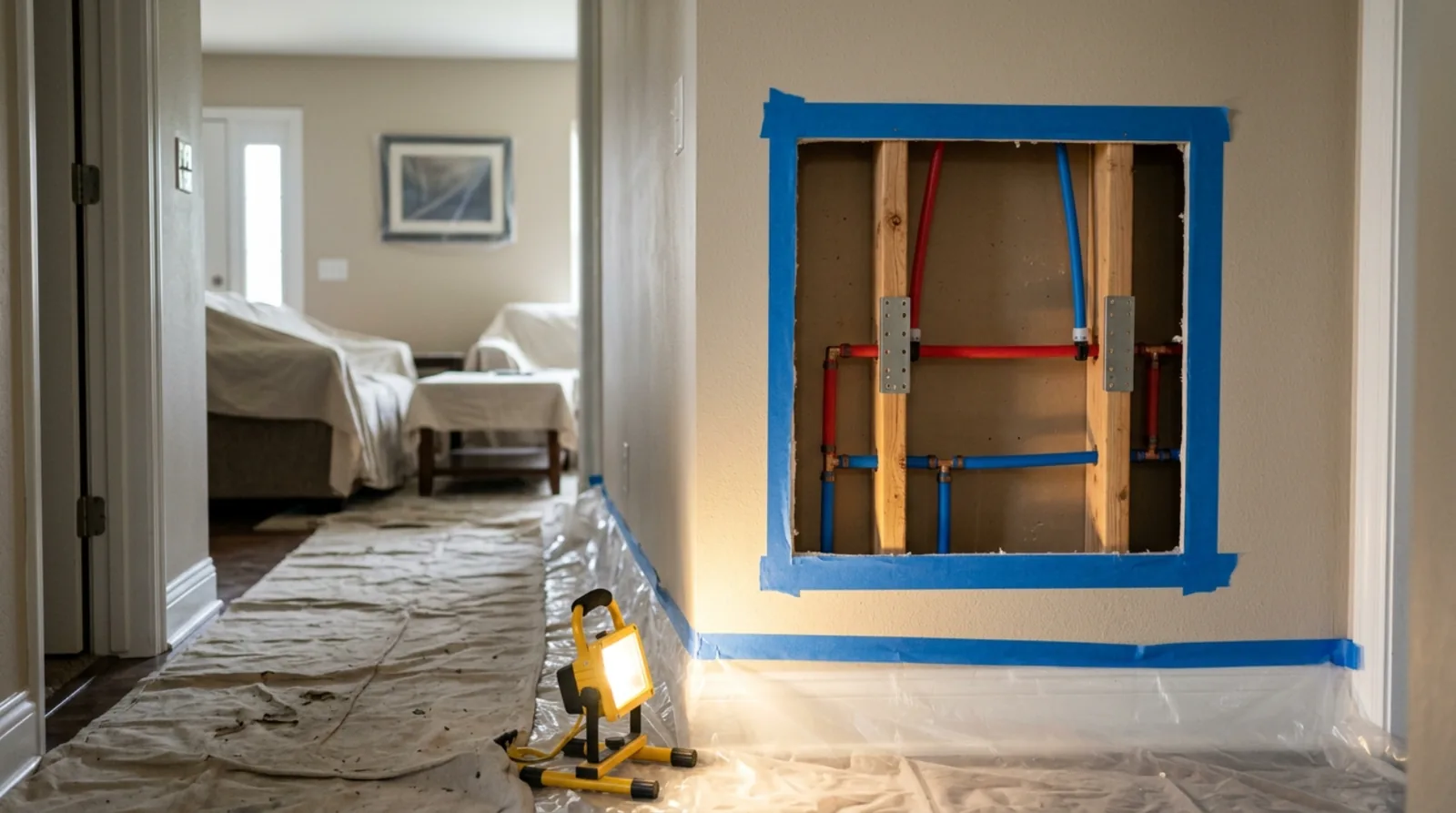
Repipe quotes confuse homeowners more than almost any other plumbing estimate, and for a defensible reason: the number genuinely varies enormously from house to house. Two homes built the same year on the same Murrieta street can land thousands of dollars apart because of foundation type, fixture count, and whether there is attic access above the hallway. Anyone who quotes a whole-house repipe over the phone without seeing the house is guessing. This guide explains what actually drives the price so you can read a written estimate and know whether you are comparing equivalent scopes.
1. Fixture Count, Not Square Footage
Repipe pricing tracks plumbing fixtures far more closely than floor area. A fixture is any point the system has to terminate: each sink, toilet, tub, shower, hose bib, washing machine box, refrigerator line, and water heater connection. Every one requires a stub-out, a shutoff, and a tested connection.
A 2,400 square foot home with two bathrooms carries meaningfully fewer connections than a 1,900 square foot home with three bathrooms and a wet bar. When you look at an estimate, find the fixture count. If two bids differ by 30 percent, the fixture count is the first place to check that they are describing the same house.
2. Foundation Type and Routing Path
Slab-on-grade construction dominates Menifee, Wildomar, Lake Elsinore, and most newer Temecula and Murrieta tracts. In a slab home, the existing supply lines usually run under the concrete, and the standard solution is to abandon them in place and reroute new lines overhead through the attic and down interior walls.
That reroute cost depends almost entirely on access. A single-story home with a walkable attic and interior walls that drop cleanly to fixtures is the easy case. A two-story home requires running lines between floors, through joist bays, and down second-floor walls — significantly more labor and significantly more drywall. Homes with a raised foundation and crawl space sit somewhere in between, and usually price favorably because the crawl space gives working room.
3. Pipe Material
Material is a real cost difference but rarely the biggest one. Copper costs more than PEX in both material and labor, because every direction change is a fitting and every fitting is a joint to make and test. The full comparison is in our post on PEX vs. copper repiping. If you are getting quotes from multiple companies, confirm which material each one priced — a PEX bid and a copper bid are not comparable numbers.
4. Drywall Repair Scope
This is where bids diverge most and where homeowners get caught. A repipe requires opening walls and ceilings. Closing them again is a separate scope, and companies handle it three different ways:
- Open only — the plumber cuts access and leaves the holes; you arrange drywall and paint yourself
- Patch to texture — holes are patched, taped, and textured, but not painted
- Patch, texture, and paint — finished to match, the most complete and the most expensive
A bid that looks cheaper is frequently a bid that stops at "open only." Before comparing numbers, find the drywall line on each estimate. Also note that texture matching on older homes — knockdown, orange peel, or the heavy textures common in 1970s and 1980s Riverside and Hemet construction — takes more skill and more time than a flat modern wall.
5. Permits and Inspection
A whole-house repipe is permitted work in California, and it should be. The permit brings a jurisdictional inspection of the new system, which is the homeowner's independent verification that the work meets code. It also creates the documented record buyers, inspectors, and insurers ask for later.
Permit fees vary by jurisdiction across Riverside County. A bid with no permit line is not a cheaper bid — it is an incomplete one, and unpermitted work becomes the seller's problem at closing. Under California law a home improvement contract must state in writing who is responsible for obtaining permits, along with the price, payment schedule, and completion date; the CSLB explains these requirements in its guidance on home improvement contracts.
6. Fixtures and Valves Replaced Along the Way
A repipe reaches every shutoff valve in the house, which makes it the cheapest moment in the home's life to replace angle stops, supply lines, hose bibs, and shower valve cartridges. Many estimates include new quarter-turn angle stops at every fixture as standard; some do not.
Shower and tub valves are the common upgrade question. Replacing a shower valve body requires wall access that the repipe is already creating — doing it later means opening the same wall twice. If the existing valves are more than 20 years old, pricing them into the repipe is usually the better economics.
7. Pressure Regulation and Water Treatment
Incoming pressure across Riverside County varies widely by elevation and zone, and a new system installed behind an unregulated or failed pressure regulator is a new system running under stress from day one. Most complete repipe estimates include a new pressure regulating valve; our post on why every home needs a pressure regulator explains what that valve is protecting.
Homeowners with hard water often add a filtration or softening system during the repipe, since the main line is already open and the plumber is already there. It is an add-on cost, not a hidden one — but it should appear as its own line, not be bundled invisibly.
8. Occupied vs. Vacant, and Schedule
Repiping an occupied home takes longer than repiping an empty one. Crews protect flooring and furniture, work around household routines, and restore water service at the end of each working day so the home stays livable. That care is worth paying for, and it is real labor time. A vacant home between tenants or before a move-in typically finishes faster.
9. What the Crew Finds Once Walls Are Open
The honest variable. Opening walls in a 40-year-old home occasionally reveals conditions nobody could quote sight-unseen: previous unpermitted repairs, rotted framing at a long-term leak, undersized original piping, or a drain line that has to be moved to route around. A good contractor handles these with a written change order signed before the work proceeds, rather than a surprise on the final invoice. If a repipe is being considered because of a slab leak, our guide to slab leak detection and repair options is the right place to start.
How to Compare Three Bids Honestly
Lay the estimates side by side and confirm each one states: pipe material and grade, fixture count, drywall scope, permit responsibility, whether angle stops and supply lines are included, whether a pressure regulator is included, the warranty on labor and on material, and the payment schedule. Under California law, the down payment on a home improvement contract cannot exceed $1,000 or 10 percent of the contract price, whichever is less. A contractor asking for half up front is a signal worth taking seriously — more of them are listed in our post on red flags when hiring a plumbing company.
Gardner Plumbing Co. quotes repipes only after walking the home, and the written estimate is the invoice price — changes happen only with your written approval. Financing is available for qualifying projects, and every repipe is permitted and inspected. CSLB #1073177, 30+ years serving Riverside County, 900+ five-star Google reviews. See how our pricing works or review financing options.
Want a real number for your house instead of a phone estimate? Call (951) 246-4337 for a free in-home repipe assessment — no trip fee, written price before work begins. Serving Temecula, Murrieta, Menifee, Corona, Hemet, Riverside, and 20+ cities across Riverside County and neighboring communities.