Repiping
PEX vs. Copper Repiping: Which Is Right for Your Home?
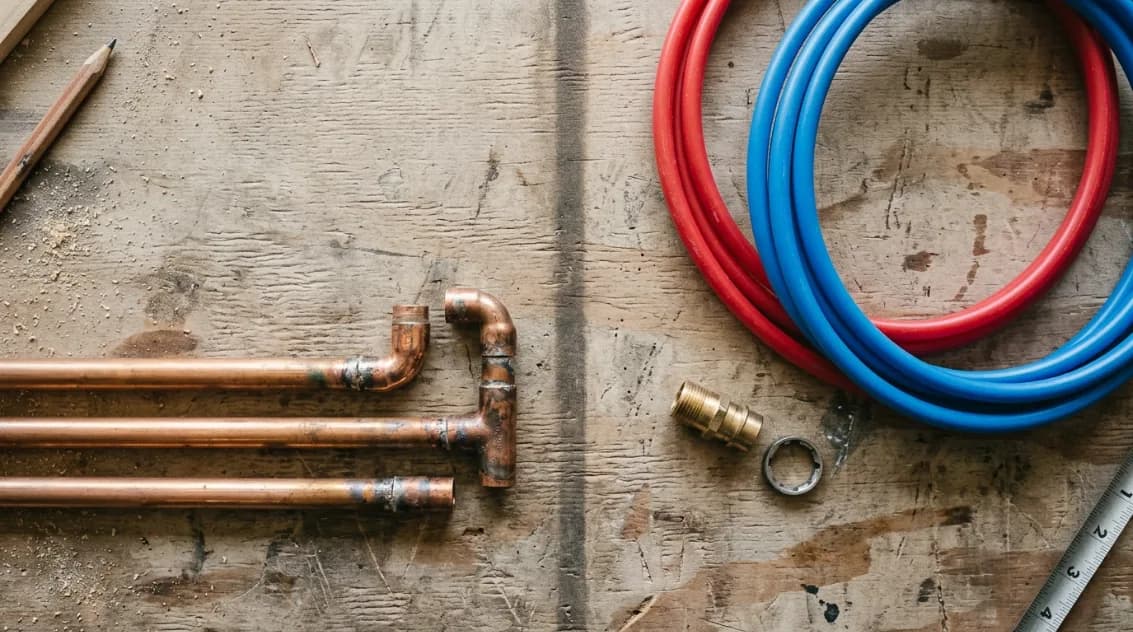
Homeowners in Temecula, Murrieta, Menifee, Corona, Hemet, and neighboring Riverside County communities who have decided to repipe almost always ask the same second question: PEX or copper? Both are approved under the California Plumbing Code, both are installed thousands of times a year across the Inland Empire, and both will outlast the galvanized or early-copper system being removed. But they are not interchangeable. They behave differently under our local water chemistry, they route differently through slab-on-grade construction, and they carry meaningfully different labor costs. This guide compares them on the terms that actually matter once a crew is standing in your home with a quote in hand.
What Each Material Actually Is
Copper supply pipe is rigid, joined with soldered or press fittings, and has been the residential standard in Southern California since roughly the 1960s. Type L copper is the common repipe grade — thicker walled than the Type M often found in tract construction. The Copper Development Association's plumbing resources document its performance history in potable water systems in detail.
PEX — cross-linked polyethylene — is a flexible polymer tubing that arrives on a spool and bends around framing instead of requiring an elbow at every direction change. It comes in three manufacturing grades (PEX-A, PEX-B, and PEX-C) that differ in how the cross-linking is achieved and in how much the tubing can flex and recover. The Plastics Pipe Institute publishes the technical standards the industry works from. If you want the broader material landscape first, our guide to copper, PEX, PVC, and galvanized pipe covers all four.
Cost: Where the Difference Actually Comes From
PEX almost always prices lower than copper on the same house, and most homeowners assume the gap is material cost. It is not — or at least, not mostly. The larger driver is labor and drywall. Copper requires a fitting and a joint at every turn, which means more open wall, more connections to pressure-test, and more hours on site. PEX runs home-run or trunk-and-branch from a manifold, bending around obstacles, so a crew opens fewer access holes and closes them faster.
That matters because in a whole-house repipe, drywall repair and paint are a real line item, not a footnote. Fewer openings means less patching, less texture matching, and a shorter timeline in the house. The tradeoff is that copper's higher cost buys a material with a longer installed track record and better scrap value at end of life. Our breakdown of what actually happens during a whole-house repipe walks through the drywall phase specifically.
How Inland Empire Water Chemistry Affects the Choice
This is where the local answer diverges from the generic one. Much of Riverside County is served by moderately hard to very hard water, and hard water interacts with each material differently.
Copper develops a protective interior oxide layer over time, but aggressive water chemistry — low pH, high dissolved oxygen, or high chloride — can prevent that layer from forming evenly and produce pitting corrosion. Pitting is the mechanism behind the pinhole leaks that show up in twenty-to-forty-year-old copper systems across Murrieta and Temecula. High velocity from excessive pressure also erodes the interior wall at elbows, which is why a repipe without addressing pressure is only half a fix.
PEX does not corrode and is not affected by pH or chloride at residential concentrations. Scale still forms inside PEX in hard water, but it does not attack the pipe wall. PEX is also more forgiving of a rare Inland Empire freeze event because the tubing can expand slightly rather than splitting. The practical takeaway: in a home that has already produced multiple pinhole leaks in copper, installing new copper under the same water chemistry invites the same outcome on a delayed clock. See our post on how hard water damages pipes and fixtures for the full mechanism.
Slab Construction Changes the Math
The majority of homes in Menifee, Wildomar, Lake Elsinore, and the newer Temecula and Murrieta tracts sit on concrete slab foundations with supply lines originally run under or through the slab. When those lines fail, the repair options are jackhammer access or an overhead reroute through the attic and down interior walls.
Overhead reroute is the standard approach for a slab home repipe, and PEX is the easier material to route that way — fewer joints in inaccessible spaces, and continuous runs from manifold to fixture with no buried connections. Copper can absolutely be rerouted overhead and often is, but every soldered joint in an attic is a joint you cannot see again. Homes with an active slab leak should read our guide on slab leak causes, detection, and repair options before deciding between a spot repair and a full repipe.
Taste, Temperature, and Noise
A handful of practical differences show up after the walls close:
- Heat loss: PEX holds heat better than copper, so hot water arrives marginally faster at distant fixtures on long runs
- Water hammer: PEX flexes and dampens pressure surges; copper transmits them, which is why rigid systems more often need arrestors
- Initial taste: new PEX can impart a faint plastic taste for the first few weeks until the system is flushed and settled; copper does not
- UV exposure: PEX degrades under sustained sunlight and cannot be run exposed outdoors; copper can
- Rodents: in rare attic infestations, rodents can chew PEX; copper is immune
None of these are decisive on their own. They are the details a good estimator raises before the contract is signed rather than after the first shower.
Which Should You Choose?
For most Riverside County homes — slab foundation, hard water, attic-accessible routing, and a homeowner who wants the shortest disruption and the smallest drywall footprint — PEX is the pragmatic choice, and it is what most modern Inland Empire repipes use. Copper remains the right answer for homeowners who want the longest-proven material, for exposed exterior runs, for homes where the existing copper failed due to pressure rather than chemistry, and for anyone who simply prefers a rigid metal system and accepts the cost.
What matters more than the material debate is that whichever is installed is installed correctly: properly sized, properly supported, pressure-tested, permitted, and paired with a pressure regulator set to a safe range. A well-installed PEX system outlives a poorly installed copper one every time.
Getting a Straight Answer for Your Specific Home
Gardner Plumbing Co. installs both materials and quotes both when a home is a genuine candidate for either. A repipe estimate includes a walk of the existing system, an assessment of routing options, a water pressure reading at the hose bib, and a written price covering pipe, fittings, fixture reconnection, permits, drywall patch scope, and cleanup. Not sure a repipe is warranted yet? Start with the warning signs that a home needs repiping, or schedule a 65-point plumbing inspection to document the system's actual condition first.
Weighing a repipe for your Riverside County home? Call (951) 246-4337 for a free in-home repiping estimate — no trip fee, written price before work begins. Gardner Plumbing Co., CSLB #1073177, serving Temecula, Murrieta, Menifee, Corona, Riverside, and 20+ cities across Riverside County and neighboring communities.