Repiping
Partial Repipe vs. Whole-House Repipe: Which Do You Need?
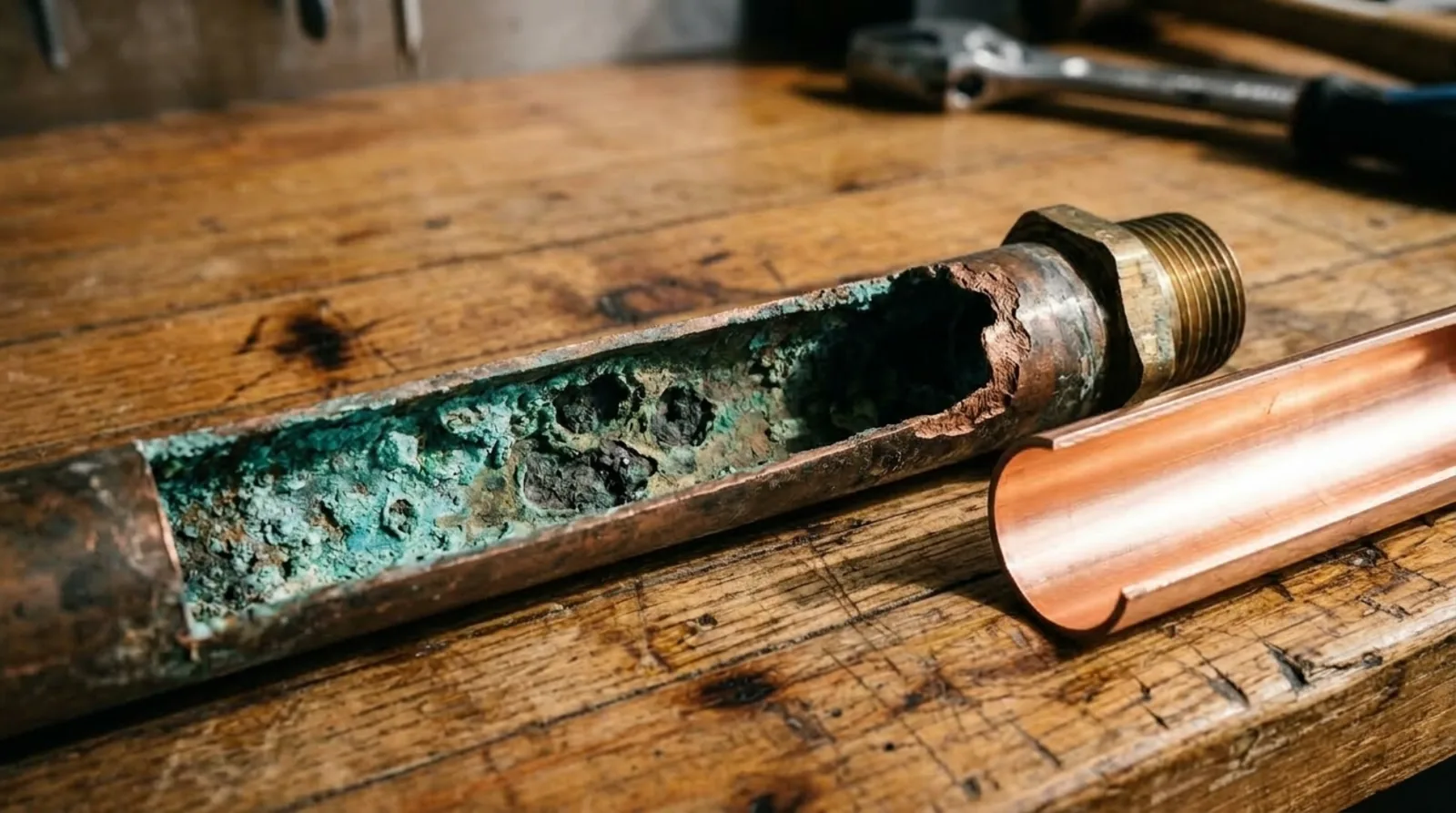
When a supply line fails, the repair menu has three tiers: patch the leak, replace the run that failed, or replace the whole system. The first is the cheapest today and the most likely to repeat. The third is the most expensive today and the one that ends the conversation. In between sits the partial repipe — replacing one branch, one bathroom group, or the hot-water side only — and it is genuinely the right answer in some homes and a false economy in others. The deciding question is not cost. It is whether the failure was caused by something local to that run, or by something affecting every pipe in the house equally.
Start With the Failure Mode, Not the Leak Location
Pipes fail for identifiable reasons, and the reason tells you how far the problem extends.
Localized causes affect one run and leave the rest of the system alone: physical damage from a nail or screw, a manufacturing defect in one fitting, a joint soldered poorly during a past remodel, erosion at a single elbow where turbulence concentrates, or a run that was improperly supported and has been rubbing against framing for twenty years.
Systemic causes affect every pipe of the same material and age simultaneously: water chemistry driving pitting corrosion, sustained pressure above safe limits, galvanized pipe reaching the end of its service life, or thermal cycling on a hot-water line. Corrosion research organizations such as AMPP, the Association for Materials Protection and Performance, study exactly these mechanisms — and the defining feature of a systemic cause is that it does not stop at the pipe that happened to fail first.
A partial repipe solves a localized cause completely. Against a systemic cause it buys time, because the rest of the system is still aging under the same conditions.
When a Partial Repipe Is the Right Call
- The home has had one leak, not a pattern, and the cause was clearly mechanical
- Part of the house was repiped during a previous remodel and only the original section remains
- A single under-slab run failed and can be rerouted overhead while the rest of the system remains accessible and sound
- Only the hot-water side is deteriorating — common, since heat accelerates corrosion — and the cold lines inspect clean
- An addition was plumbed with a different, sound material and only the older portion is at issue
- The homeowner is selling within a short window and is addressing a documented defect rather than pre-empting future ones
The hot-only scenario deserves emphasis. Hot water lines routinely fail years before the cold lines in the same house. Where an inspection confirms the cold side is genuinely sound, repiping hot only is a defensible, honest recommendation — not a shortcut.
When a Partial Repipe Is False Economy
- Two or more pinhole leaks in the last two years, anywhere in the house
- Original galvanized steel supply lines — the whole system is the same age and the same material
- Discolored or rusty water at multiple fixtures, indicating interior corrosion throughout
- Pressure dropping progressively across the house as scale narrows every line
- A plumber has already patched the same general area more than once
- The home is on slab and the failed run is under concrete — if you are opening the attic to reroute one line, the marginal cost of rerouting the rest is small
That last point is the economics most homeowners miss. A large share of repipe cost is mobilization, access, and drywall — not linear feet of pipe. Doing half the house now and the other half in three years means paying the setup cost twice and opening drywall twice. Our breakdown of what determines repipe cost walks through where the money actually goes. And if the warning signs are already showing up across the house, the repiping signs guide is the honest first read.
The Evidence That Should Decide It
Before choosing, get three pieces of information:
A static pressure reading. Taken at an outside hose bib with everything off. Anything sustained above 80 PSI is stressing every fitting in the home and needs a pressure regulator regardless of which repipe scope you choose.
A physical look at removed pipe. Ask the plumber to cut open the failed section. Wall thickness, interior scale, and pitting on the inside surface tell you whether this pipe was uniquely unlucky or representative of the whole system.
A documented inspection of the remaining runs. Visible pipe in the garage, attic, and under sinks; water clarity at each fixture; flow rate at the farthest fixture. A 65-point plumbing inspection produces this in writing, which also matters later at resale or on an insurance question.
A Note on Mixing Materials
Partial repipes create transitions between old and new pipe, and those transitions matter. Copper joined directly to galvanized steel sets up galvanic corrosion that eats the connection from the inside — dielectric unions or approved transition fittings are required. PEX to copper needs proper transition fittings as well. These are routine for a licensed plumber and a frequent failure point in unpermitted work, which is one more reason partial repipes should be permitted and inspected the same as full ones.
How to Decide
One leak with a mechanical explanation, on a system that inspects clean everywhere else: repipe the affected run and move on. A second leak, galvanized pipe, discolored water, or falling pressure across the house: the system is telling you it has reached the end, and partial work is a payment plan with interest.
Gardner Plumbing Co. quotes both scopes when a home is a legitimate candidate for either, and will say plainly when a partial repipe is the honest recommendation. Every repipe — partial or whole-house — is permitted, inspected, and backed by a written estimate that does not change without your approval. CSLB #1073177, 30+ years serving Riverside County, 900+ five-star Google reviews. Curious what the work actually looks like day to day? See what to expect during a repipe.
Deciding between a partial and a full repipe? Call (951) 246-4337 for a free in-home repiping evaluation — both options quoted in writing, no trip fee. Serving Murrieta, Temecula, Menifee, Lake Elsinore, Hemet, Riverside, and neighboring communities.