Repiping
Galvanized Pipe: Why Replacement Is Inevitable
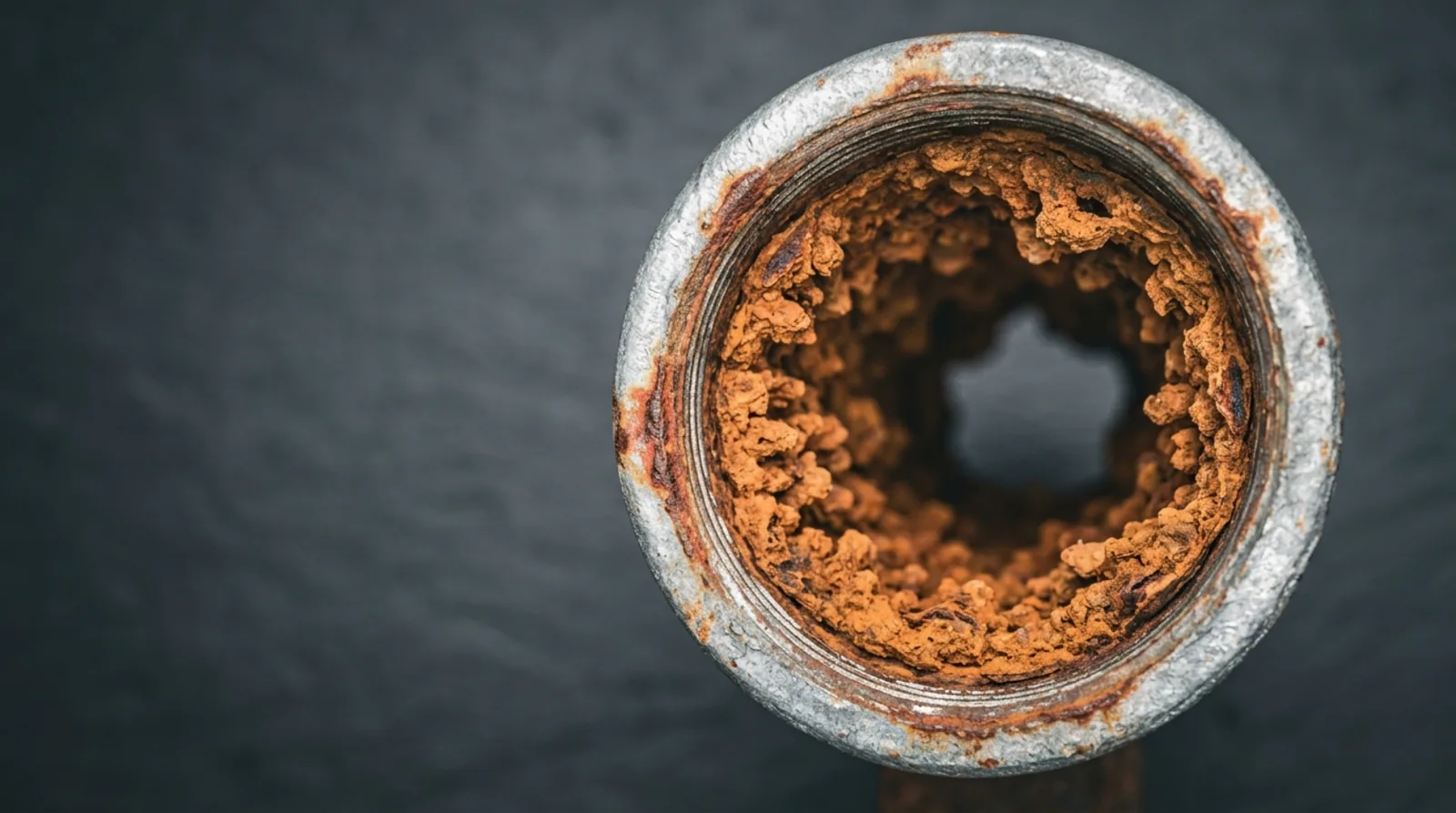
Some plumbing problems are judgment calls. Galvanized steel supply pipe is not one of them. It is a material with a finite service life that corrodes from the inside where nobody can see it, and it cannot be cleaned, coated, or restored to its original condition. Homes across older neighborhoods in Riverside, Hemet, Perris, San Jacinto, and Redlands still have it — usually the original 1940s through 1960s installation, sometimes partially replaced during a remodel. If yours does, the question is not whether it gets replaced. It is whether that happens on your schedule or on the pipe's.
What Galvanized Pipe Is and Why It Fails
Galvanized pipe is steel dipped in a protective zinc coating. The zinc is a sacrificial barrier — it corrodes preferentially so the steel underneath does not. For the first few decades it works well, which is why the material was the residential standard for half a century.
Then the zinc is consumed. Once it is gone, water contacts bare steel and the steel begins to rust. Rust occupies more volume than the steel it replaces, so the corrosion product builds inward, progressively narrowing the pipe. A 3/4-inch line can lose most of its effective diameter to interior tuberculation while the outside looks completely intact. Eventually the wall thins to the point of perforation and the pipe leaks — often at a threaded joint, where the wall was thinnest from the start.
There is no maintenance that reverses this. Nothing removes tuberculation from inside residential galvanized pipe and restores the wall. That is the whole argument.
How to Tell If Your Home Has It
Find exposed supply pipe — in the garage, at the water heater connections, under a sink, or in a crawl space — and check:
- Color — dull silver-gray, often with surface rust at threads; copper is unmistakably copper-colored
- The magnet test — a magnet sticks to galvanized steel; it will not stick to copper or brass
- Threaded fittings — galvanized systems use threaded connections and a visible thread collar at each joint, rather than the smooth soldered sweat joints of copper
- Sound — tapping galvanized produces a dull thud rather than copper's higher ring
- Age — homes built before about 1960 were almost certainly plumbed with it originally
One caution: partial replacement is extremely common. A kitchen remodel in 1995 may have swapped the visible pipe under the sink for copper while leaving galvanized inside every wall. Seeing copper at one fixture proves nothing about the rest of the house. Our overview of pipe materials covers how to identify each type.
The Symptoms, in the Order They Appear
Discolored water first. Brown, yellow, or rust-tinted water, worst on the first draw in the morning or after the house has sat empty. That is iron oxide flaking from the interior wall.
Then pressure loss. Progressive, usually so gradual nobody notices until a guest comments on the shower. It is worst at the fixtures farthest from the main and worst when two fixtures run at once. Hot lines degrade faster than cold because heat accelerates the reaction — our post on water pressure problems and solutions covers how to distinguish this from a regulator issue.
Then fixture and appliance trouble. Aerators clogging repeatedly with rust particles, toilet fill valves fouling, and dishwashers and washing machines catching debris in their inlet screens.
Then leaks. Usually at threaded joints, usually starting as a weep, occasionally as a sudden failure. Once one joint goes, others in the same vintage are on the same clock.
The Water Quality Dimension
Galvanized pipe carries a concern beyond flow. Corrosion scale inside galvanized lines can accumulate metals that the water passed through earlier in its life — which is why galvanized service lines that were ever downstream of lead components receive specific regulatory attention. The EPA's service line inventory requirements include a distinct material classification called "galvanized requiring replacement" for service lines in exactly this situation.
For most Riverside County homes the practical water quality issue is simpler — iron, sediment, and taste — but it is a real quality-of-life factor, and it is one that filtration treats as a symptom rather than a cause. Our guide to how water quality affects fixtures and appliances covers the downstream effects.
Why Spot Repairs Do Not Work Here
With copper, a single pinhole can legitimately be a one-off — and a partial repipe can be the right answer, as covered in partial vs. whole-house repiping. Galvanized is different, because every line in the house is the same material, installed the same year, carrying the same water. When one joint fails from wall loss, the rest are not far behind.
There is also a specific technical trap: joining new copper directly to old galvanized creates a galvanic couple that corrodes the connection aggressively from the inside. Proper dielectric unions are required, and unpermitted patch repairs routinely skip them — producing a new leak at the very joint that was supposed to fix the old one.
Doing It on Your Schedule
A planned repipe is a scheduled project with a written price, a permit, an inspection, and drywall repair coordinated in advance. An emergency repipe is the same work done after water has already been in the walls, with remediation costs layered on top and an insurance conversation that may not go your way — our post on whether homeowners insurance covers plumbing damage explains why gradual failures often are not covered.
Replacement material is usually PEX or copper, and the comparison is in PEX vs. copper repiping. Either is a permanent end to the galvanized problem. Gardner Plumbing Co. repipes galvanized homes across Riverside County with permitted, inspected work, a written estimate that does not change without your approval, and a clear scope for drywall and cleanup. CSLB #1073177, 30+ years local, 900+ five-star Google reviews.
Rusty water or falling pressure in an older home? Call (951) 246-4337 for a free in-home repiping evaluation — no trip fee, written price before work begins. Gardner Plumbing Co. serves Riverside, Hemet, Perris, San Jacinto, Moreno Valley, Redlands, and 20+ cities across Riverside County and neighboring communities.